

Managing Taints
Updated at:2025-10-27
Overview
Taints are node attributes used to restrict certain pods from being scheduled onto a node. To allow the scheduler to place pods on a tainted node, corresponding tolerations must be configured. Common use cases include:
- Dedicated nodes: Nodes reserved exclusively for specific users or workloads.
- Special hardware nodes: Ensure that only pods requiring specialized hardware (e.g., GPUs) are scheduled on these nodes.
- Taint-based eviction: Apply NoExecute taints to nodes and configure matching tolerations for protected pods to enable selective pod eviction.
This document provides guidance on managing taints in the Cloud Container Engine (CCE) console, including batch addition and quick deletion of taints.
Add taints in batch
Prerequisites
- You have successfully created a CCE cluster. For details, see [Create Cluster](CCE/Operation guide/Cluster management/Create cluster.md).
Operation steps
- Sign in to the Baidu AI Cloud official website and enter the Cloud Container Engine (CCE) management console.
- Click Cluster Management - Cluster List in the left navigation bar, then click the target cluster name on the Cluster List page to access the Cluster Management page.
- On the Cluster Management page, click Node Management - Nodes, then click Label and Taint Management in the upper right corner of the node list to access the Label and Taint Management page.
- On the Label and Taint Management page, select nodes in batch and click Edit Taints.
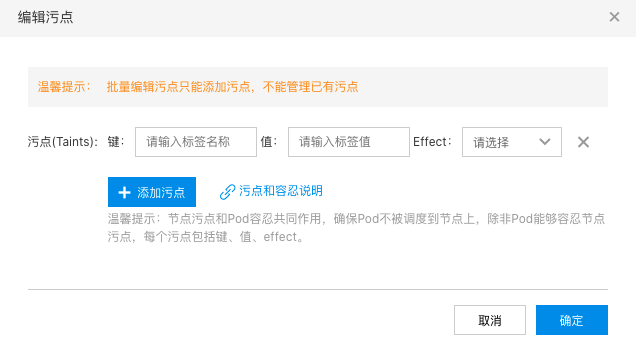
- Set the taint key, value, and effect in the pop-up Edit Label dialog. For more information, see Taints and Tolerance Description .
-
Click the OK button to finalize the batch addition of taints.
Description
- Select a specific node to manage all its taints. For batch editing of taints, only adding taints is allowed, while managing existing ones is not.
- Node taints and pod tolerations work together. Once taints are configured on a node, they can prevent pod scheduling to that node or cause eviction of pods, unless the pods have matching tolerations for the taints.
- Each node can have one or more taints applied, indicating that pods unable to tolerate these taints will not be scheduled on the node.
Delete taints
Prerequisites
- You have successfully created a CCE cluster. For details, see [Create Cluster](CCE/Operation guide/Cluster management/Create cluster.md).
Operation steps
- Sign in to the Baidu AI Cloud official website and enter the Cloud Container Engine (CCE) management console.
- Click Cluster Management - Cluster List in the left navigation bar, then click the target cluster name on the Cluster List page to access the Cluster Management page.
- On the Cluster Management page, click Node Management - Nodes, then click Label and Taint Management in the upper right corner of the node list to access the Label and Taint Management page.
- On the Label and Taint Management page, select a node and click the Delete icon next to the taint.
- Click the OK button in the deletion confirmation dialog box to quickly delete taints.
System taints description
When certain issues occur with a node, Kubernetes will automatically add a taint to the node. Currently, the built-in taints include:
- node.kubernetes.io/not-ready: The node is not ready. This means the node's Ready status is set to “False.”
- node.kubernetes.io/unreachable: The node controller cannot reach the node. This means the node's Ready status is set to “Unknown.”
- node.kubernetes.io/memory-pressure: The node is experiencing memory pressure.
- node.kubernetes.io/disk-pressure: The node is experiencing disk pressure.
- node.kubernetes.io/pid-pressure: The node is experiencing PID pressure.
- node.kubernetes.io/network-unavailable: The node’s network is unavailable.
- Node.kubernetes.io/unschedulable: This node cannot be scheduled.
- node.cloudprovider.kubernetes.io/uninitialized: When the kubelet starts with an "external" cloud platform driver specified, it will apply a taint to this node to mark it as unavailable. Once a controller in the cloud-controller-manager initializes the node, the kubelet will remove this taint.