

Execute SQL Statement on an Object
Updated at:2025-11-03
API description
This API is designed to execute SQL statements on specified objects in the Bucket and return the selected content. The requester must have read permission for the selected object. Before using SelectObject, ensure the corresponding bucket and object exist. For details, refer to the SelectObject Developer Documentation.
Details of Message Format:
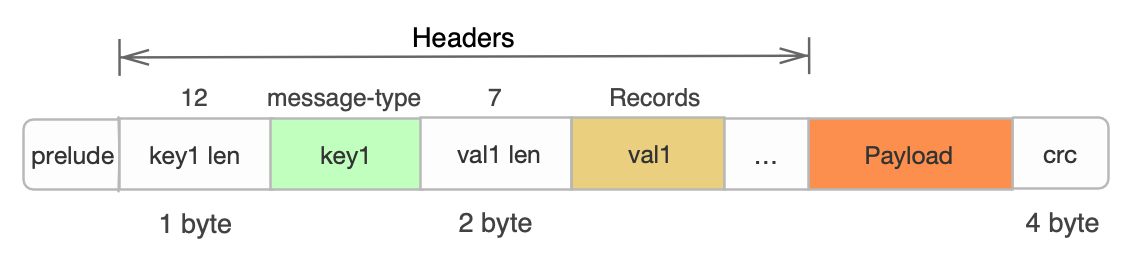
- The prelude part consists of 8 bytes in total: The first 4 bytes indicate the total length of the message, and the last 4 bytes indicate the total length of the header.
The total length of chunk (value stored in the first 4 bytes of prelude) - total length of header - 8 bytes of prelude - 4 byte of crc32 = total length of payload data; crc32 indicates the erasure code of the entire message- Headers include custom <key,value>: "message-type": {"Records", "Cont", "End"}; "error-code": specific error code; "error-message": "detailed error message".
- Payload indicates returned raw data in any format. Continuation message Payload includes BytesScanned and BytesReturned fields indicating the select progress.
Request URI
POST /v1/{bucketName}/{objectKey}?select
| Parameter name | Parameter type | Required or not | Description | Example value | Parameter location |
|---|---|---|---|---|---|
| bucketName | String | Yes | Bucket name | "bucketName_example" | Path |
| objectKey | String | Yes | Object name | "objectKey_example" | Path |
| type | String | Yes | The target object type for select, currently supporting json/csv | "type_example" | Query |
Parameters of request body
Description of the data structure of request body fields
| Parameter name | Parameter type | Required or not | Description | Example value |
|---|---|---|---|---|
| selectRequest | SelectRequest | Yes | The root node of the JSON body |
Description of SelectRequest field data structure
| Parameter name | Parameter type | Required or not | Description | Example value |
|---|---|---|---|---|
| expression | String | Yes | sql statements encoded in Base64 | c2VsZWN0IGNvdW50KCopIGZyb20gbxkl2JqZWN0IHdoZXJlIF80ID4gNDU= |
| expressionType | String | Yes | The syntax type of the query statement only supports "SQL" | SQL |
| inputSerialization | InputSerialization | Yes | Input stream node, whose child nodes describe the format information of the object to be queried | |
| outputSerialization | OutputSerialization | Yes | Output stream node, whose child nodes describe the return format information of the query results | |
| requestProgress | RequestProgress | No | + requestProgress No - The progress information node for the select operation. The child nodes of the node describe the execution progress of the select operation, and periodically return the information to the user every 3 seconds |
Description of InputSerialization field data structure
| Parameter name | Parameter type | Required or not | Description | Example value |
|---|---|---|---|---|
| compressionType | String | No | Specify whether the queried object is compressed, with optional values "NONE" or "GZIP" | NONE |
| csv | Csv | No | csv node, the child nodes of which describe relevant information about the CSV file |
Description of CSV field data structure
| Parameter name | Parameter type | Required or not | Description | Example value |
|---|---|---|---|---|
| fileHeaderInfo | String | No | Option NONE/IGNORE/USE, specifying the header information in the first line of the CSV file. The default value NONE indicates no header information, IGNORE indicates that header information exists but is ignored. Both NONE and IGNORE mean that only column number can be used to extract a specific column; USE indicates the usage of header information, where only header names can be used to extract a specific column | NONE |
| recordDelimiter | String | No | Specify the line separator for CSV files, encoded in Base64. The default value is \n (optional), with a maximum of 2 characters, such as \r\n | \r\n |
| fieldDelimiter | String | No | Specify the delimiter for CSV files, encoded in Base64. The default value is , (optional), with a maximum of 1 character, such as ; | ; |
| quoteCharacter | String | No | Specify the quote character for CSV files, encoded in Base64. The line breaks and column delimiters within quotes in the CSV file will be considered ordinary characters. The default value is double quotes " (optional), with a maximum of 1 character, such as single quotes ' | ' |
| commentCharacter | String | No | Specify the comment character of the CSV file, encoded in Base64. Lines starting with this character can be ignored; the default value is # (optional), with a maximum of 2 characters, such as //. | // |
Description of OutputSerialization field data structure
| Parameter name | Parameter type | Required or not | Description | Example value |
|---|---|---|---|---|
| outputHeader | Boolean | No | Output CSV header information at the beginning of the result; it is defaulted to false; it requires the fileHeaderInfo field value to be USE. When this value is true, corresponding CSV header names will be added in the first line of each Records message in the response results; options are false/true | false |
| csv | Csv | No | CSV node, the child nodes of which describe relevant information about the CSV data returned |
Description of RequestProgress field data structure
| Parameter name | Parameter type | Required or not | Description | Example value |
|---|---|---|---|---|
| enabled | Boolean | No | Describe whether the periodic return of progress information is required, with options false/true. If data filtering is time-consuming and may cause a 504 timeout, setting this to true can maintain the HTTP connection | false |
Response body parameters
Description of the data structure of response body fields
Request example
JSON
1POST /v1/bucketName_example/objectKey_example?select&type=type_example
2 <Common request headers>
3{
4  "selectRequest" : {
5    "outputSerialization" : {
6      "outputHeader" : false,
7      "csv" : {
8        "quoteFields" : "ALWAYS",
9        "recordDelimiter" : "Cg==",
10        "quoteCharacter" : "Ig==",
11        "fieldDelimiter" : "LA=="
12      }
13    },
14    "expression" : "c2VsZWN0IGNvdW50KCopIGZyb20gbxkl2JqZWN0IHdoZXJlIF80ID4gNDU=",
15    "expressionType" : "SQL",
16    "requestProgress" : {
17      "enabled" : false
18    },
19    "inputSerialization" : {
20      "csv" : {
21        "fileHeaderInfo" : "NONE",
22        "recordDelimiter" : "\\r\\n",
23        "quoteCharacter" : "'",
24        "fieldDelimiter" : ";",
25        "commentCharacter" : "//"
26      },
27      "compressionType" : "NONE"
28    }
29  }
30}
Response example
JSON
1HTTP/1.1 200 OK
2 <Common response headers>
3{ }
Error code
Please refer to the general error codes