Set bucket read-write permissions
Updated at:2025-11-03
Overview
To enhance the security of data stored in BOS, we offer diverse multilevel permission management options. The BOS permission system is divided into three levels:
- Bucket Standard Permissions: Common industry permission settings include private, public-read, and public-read-write.
- Coarse-Grained Custom Permissions: More fine-grained permissions than standard ones allow setting READ, LIST, WRITE, FULL_CONTROL and MODIFY permissions for specific users, and specifying accessible resources, IP addresses, and referer allow lists.
- Fine-grained custom permissions: API-level fine-grained custom permissions provided by BOS. Configurable API categories include 18 types, such as GetBucket, GetObject, PutObject and DeleteObject. You can customize the corresponding permission for each category.
Set bucket read-write permissions
- Sign in to the Baidu AI Cloud Object Storage (BOS) Management Console.
- From the bucket list on the left, select the bucket for which you want to set permissions, then click its name to enter the bucket management directory.
- Select the Configuration Management tab in the top navigation bar.
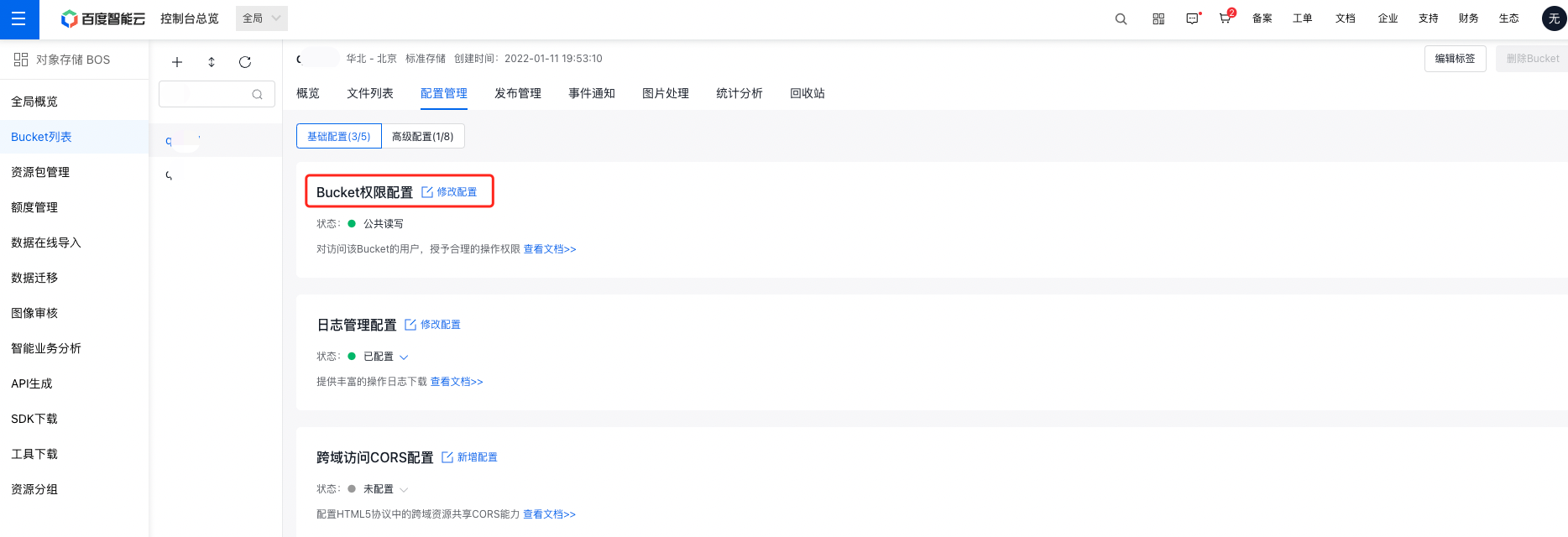
- On the Configuration Management page, select Basic Configuration, and click the Modify Configuration in the Bucket Permission Configuration area to configure the permissions of the bucket.
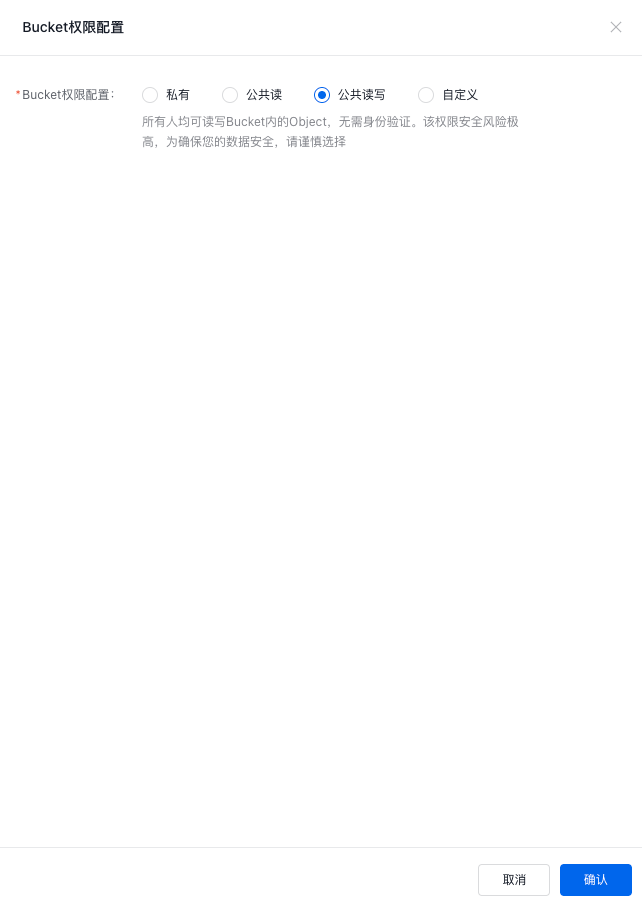
- A bucket can be set to private, public read, or public read-write. For more requirements, you can select custom permissions and click Add Custom Authorization to add them.
-
In the pop-up Add Custom Permission form, fill in the corresponding items for authorization.
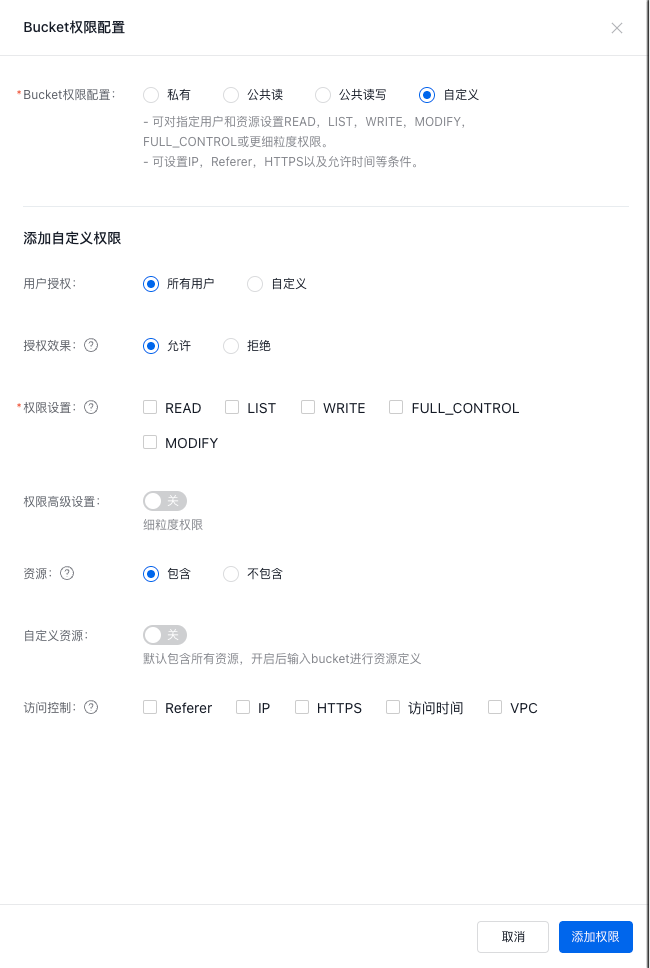 For the relevant configuration process of custom permissions, you can refer to the following table for operation.
> **Description:** > - If you wish to perform access control based on IP addresses, you need to use the official bucket domain name or a custom domain name with CDN acceleration disabled for access. If you use the official CDN domain name or a custom domain name with CDN acceleration enabled to access BOS, the IP settings will be invalid. > - **VPC-level access control currently only supports the North China - Beijing, North China - Baoding, and East China - Suzhou regions**. If you need support for other regions, please contact us through your business manager or by submitting a ticket (https://ticket.bce.baidu.com/?_=1603103630709#/ticket/create). > > - **Signature version conditional control is currently available in the allow list**. If you have needs, please contact us through your business manager or by submitting a ticket (https://ticket.bce.baidu.com/?_=1603103630709#/ticket/create). > > **数Data safety prompt:** > - With **public read-write permission**, anyone can directly read and write data in your bucket without authentication, which poses extremely high security risks. It is recommended to strictly follow the [principle of least privilege](BOS/Developer Guide/Data Security/Principle of Least Privilege.md) to avoid data security risks. > - **LIST permission** supports viewing the list of objects in the bucket and obtaining all unfinished multipart upload tasks. It is not recommended to grant LIST permission to all users; please strictly follow the principle of least privilege.Configuration name Configuration description User authorization - All users: Refer to that this configuration applies to all users
- Custom: Refer to that this configuration applies to specified users. After selecting Custom, you need to enter the user ID you wish to specify. The user ID can be viewed in the user center. Additionally, BOS supports setting multiple user IDs simultaneously, with each ID entered on a separate line (no punctuation is required at the end of each line). To apply to all users, enter "*" (one "*" at most is supported). You may also enter AuthenticatedUsers to grant permission to all registered Baidu AI Cloud users
- All the above user IDs refer to the root account IDs. If you need to control the permissions of the user IDs of IAM users, you need to perform corresponding configurations through IAM identity and access management: IAM Identity and Access Management
Authorization Effect - It is used to set the operation effects for authorized users. If “Allow” is selected, the configured permissions will grant users the effect of “Allow”; if “Deny” is selected, the configured permissions will grant users the effect of “Deny”
Authorization Configuration - Coarse-grained custom permissions: Include READ, LIST, WRITE, MODIFY, FULL_CONTROL permissions
- Fine-grained custom permissions: Users can click "Advanced Settings" to expand the fine-grained permission list and select one or more as needed to form a new custom permission
- Fine-grained and coarse-grained permissions (READ, LIST, WRITE, FULL_CONTROL and MODIFY) do not interfere with each other and may be granted simultaneously
- Coarse-grained permissions have higher priority than fine-grained permissions. If both coarse-grained permissions and fine-grained permissions are assigned, coarse-grained permissions will override fine-grained permissions, and take the priority. You may combine coarse-grained and fine-grained permissions as needed
Resources - Specify the resource scope to which this permission applies.
- Here, "Include" refers to the effective resource scope. Resources must start with the bucket name. If a resource contains only one slash, it cannot end with a slash and must terminate with a wildcard "*". Multiple resources can be set, with one per line and each ending with a wildcard. Example: `myBucket, myBucket/*, myBucket/myfolder/object*`. If the resource field is left blank, it is equivalent to "Bucket Name".
- Here, "Exclude" refers to setting permissions for objects outside the specified range, and the filling method of configuration is the same as that of “Include”. Selecting "Exclude" while leaving the field blank is equivalent to no configuration. The default configuration applies here, encompassing both the bucket itself and all objects within it.
Access control - Referer: Set the referer allow list. Each referer is separated by a line break, and each referer supports a maximum of one wildcard `*`. You may also select whether to allow null referer. When "Allow null referer" is selected, HTTP requests containing referers from the allow list or null referers are permitted; when "Do not allow null referer" is selected, only HTTP requests with referers from the allow list are permitted, while null referers are denied.
- IP address: Specify the list of IP addresses with this permission, and identify the IPs using the CIDR method. Multiple IP addresses can be set, with one per line. Each line supports one wildcard `*` at most and must end with `.*`. Examples: `192.168.1.*` or `192.168.0.1/24` `192.168.0.100``192.168.*`
- HTTPS protocol: The allow list only supports HTTP and HTTPS protocols. If you need to use the HTTPS protocol, you need to check this option
- Access time: BOS supports setting access times for custom permissions. You can set the minimum and maximum times in the access time
- VPC: BOS supports VPC-level access control for custom permissions. You can allow or deny specific VPCs accessing your bucket by selecting the account VPC ID in the console or setting another account VPC ID via “Input Other VPCID”
- Signature version: You can specify the S3-compatible V2 signature version for BOS to allow or deny resource access
- Click OK to complete the configuration.
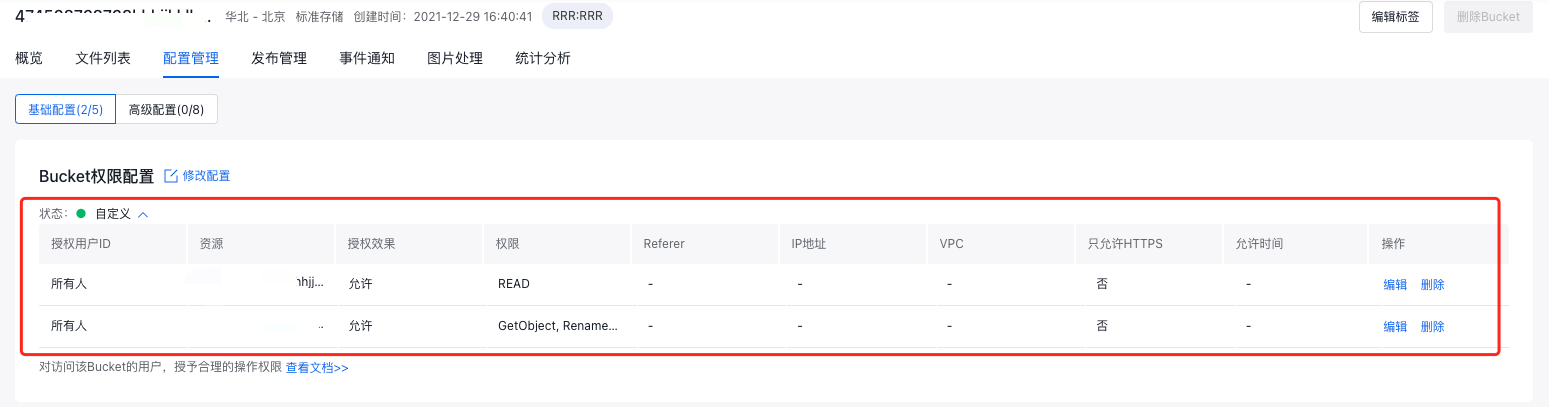
- After the configuration is completed, you can see the generated permission records in Bucket Permission Configuration, and you can adjust the existing permissions through the Modify and Delete buttons.