

Getting Started with BOS
Register a Baidu AI Cloud account
Both individual and enterprise users should first register a Baidu AI Cloud account and then use the BOS. If you have completed account registration, please sign in to the Baidu AI Cloud official website. Click "Free Registration" at the top right of the page to complete account registration. For registration steps, please refer to Account Registration Instructions.
Certification
After registering a Baidu AI Cloud account, complete primary real-name authentication. For certain products like Baidu AI Cloud Object Storage (BOS), you are required to complete advanced real-name authentication due to product characteristics and risk control policies.
Complete unified primary real-name authentication
Users must complete real-name authentication before activating the BOS service; otherwise, activation will fail. Each account only needs authentication once. Users can choose either individual or enterprise authentication as required.
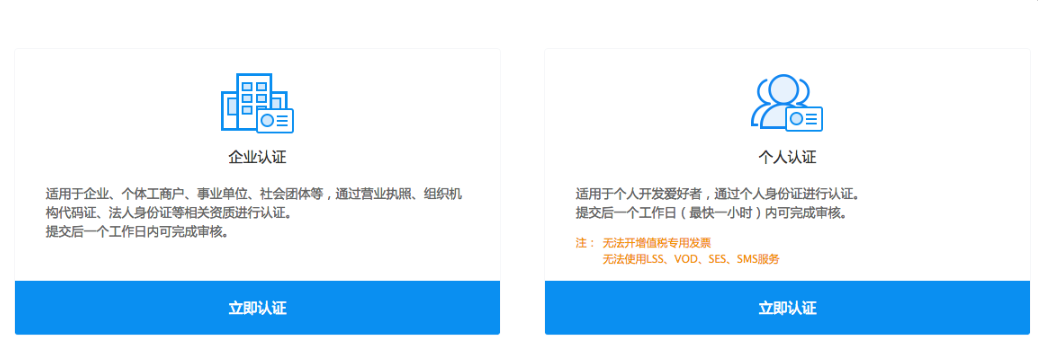
After logging in, click on "Security Certification" under your username in the upper-right corner of the console to access the verification page. Then select "Real-name Authentication." Users can choose "Enterprise Authentication" or "Personal Authentication" based on their situation. Once authentication is successful, you can use all Baidu AI Cloud products. According to the latest risk control policy, advanced real-name authentication is required before using the Baidu AI Cloud Object Storage (BOS).
Complete advanced real-name authentication
As per risk control requirements, beginning April 19, 2021, users of Baidu AI Cloud Object Storage (BOS) must complete Baidu AI Cloud advanced real-name authentication. This applies to both individual and enterprise users.
-
Users activating the BOS service after April 19, 2021, must complete Baidu AI Cloud advanced real-name authentication before using the BOS service. Please complete this certification during activation in the BOS console.
- Advanced Real-name Authentication of Individual User: Download the Baidu AI Cloud App, log in, navigate to "My Account - Personal Authentication - Real-Name Authentication" to complete the process. For details, see Advanced Real-name Authentication of Individual User.
- Advanced Real-name Authentication of Enterprise Users: After signing in to Baidu AI Cloud Console, click the avatar in the upper-right corner to access the User Center - Real-name Authentication module. Click the Add Advanced Real-name Authentication button for advanced real-name authentication of enterprise users. For detailed steps, refer to [Advanced Real-name Authentication of Enterprise Users](UserGuide/Certification/Enterprise Real-name Certification/Overview.md).
- Users (individual or enterprise) who activated BOS services before April 19, 2021 should complete advanced real-name authentication as soon as possible. Before completing authentication, your BOS service can be used normally. For authentication, refer to [Advanced Real-name Authentication of Individual Users](UserGuide/Certification/Personal Real-name Certification/Overview.md) and [Advanced real-name Authentication of Enterprise User](UserGuide/Certification/Enterprise Real-name Certification/Overview.md) of Baidu AI Cloud.
Cost description
- Charge items: BOS service covers storage fees, traffic fees, request times fees, and data processing fees. For the billing logic of charge items, please refer to Charge Items
- Charge type: You can choose between Pay-As-You-Go and [Resource Package Billing](BOS/Product pricing/Product price/Resource Package Charge Type/Resource Package Overview.md). For Pay-As-You-Go mode, BOS charges in real time by minute (rounded up if under 1 minute) and issues hourly bills through Baidu AI Cloud Finance. Another charge type - resource package, is a subscription-based purchase mode. After purchasing a resource package, your usage fees will first be deducted from the resource package, with any excess charged on a postpay basis.
Note:
- Before using the "pay-as-you-go" mode, ensure that your account has no outstanding debts.