Recycle bin

CDS

  • API Reference
    • Disk Related Interfaces
  • Dedicated Cluster Operation Guide
    • Charge
    • Create a dedicated cluster
    • Create Cloud Disk Server in Dedicated Cluster
    • Expand Dedicated Cluster
    • View Dedicated Cluster Information
    • What Is a Dedicated Cluster
  • Disk Operation Guide
    • Basic Operations
      • Create cloud disks
      • Disk encryption
        • Encrypt Data Disk and Snapshot
        • Encrypt System Disk and Image
        • Encryption Overview
      • Format cloud disks
        • Format Disk Partition on Linux System
        • Format Disk Partition on Windows System
        • Overview
      • Monitor alarm
      • mount Cloud Disk Server
      • Recycle bin
      • Release cloud disks
      • Tag Management
      • Unmount Cloud Disk Server
    • Billing management
      • Renew cloud disks
      • Shift Charge
    • Elastic Operations
      • Burst performance capability
      • Change cloud disk type
      • Performance preconfiguration
        • Use Performance Pre-Configuration
        • What Is Performance Pre-Configuration
      • Resize cloud disks
        • Expansion Overview
        • Extend Disk Partition on Linux Data Disk
        • Extend Disk Partition on Linux System Disk
        • Extend Disk Partition on Windows Data Disk
        • Extend Disk Partition on Windows System Disk
  • FAQs
    • Billing Problems
    • Common Questions Overview
    • Configuration-related questions
    • Fault-related questions
    • Performance-related questions
    • Security Problems
  • Peripheral Tools
    • CDSCMD Tool
      • Configure CDS CMD Tool
      • Install CDS CMD Tool
      • Operate Disk Using CDS CMD Tool
      • Overview
      • Tool Version History
  • Product Description
    • Application scenarios
    • Disk Status
    • Disk types
    • Product advantages
    • Product features
    • Product functions
    • Product Introduction
    • Type and Region
  • Product pricing
    • Disk charge type
      • Pay as you go
      • Subscription billing
    • Disk Expiration and Debt Reminder
    • Snapshot Charge Type
    • Universal Storage Capacity Package GSCP
  • Product Updates
    • Function Release Records
    • Product Announcement
      • Adjustments to prepay Disk renew, shift charge, and Unsubscribe Operations
  • Service Level Agreement (SLA)
    • Baidu Intelligent Cloud Block Storage Trusted Cloud
    • CDS Service Level Agreement (SLA V2_0)
  • Snapshot Operation Guide
    • Disk Snapshot
      • Automatic snapshot
      • Create a custom image
      • Create CDS disk from snapshot
      • Cross-region replication
      • Delete a snapshot
      • Manual Snapshot
      • Snapshot Rollback
      • Tag Management
    • Instance snapshots
      • Instance snapshots
    • Introduction to snapshot
      • Instructions for use
      • Snapshot chain
  • Typical Practices
    • Block Device Persistent Naming
All documents
menu
No results found, please re-enter

CDS

  • API Reference
    • Disk Related Interfaces
  • Dedicated Cluster Operation Guide
    • Charge
    • Create a dedicated cluster
    • Create Cloud Disk Server in Dedicated Cluster
    • Expand Dedicated Cluster
    • View Dedicated Cluster Information
    • What Is a Dedicated Cluster
  • Disk Operation Guide
    • Basic Operations
      • Create cloud disks
      • Disk encryption
        • Encrypt Data Disk and Snapshot
        • Encrypt System Disk and Image
        • Encryption Overview
      • Format cloud disks
        • Format Disk Partition on Linux System
        • Format Disk Partition on Windows System
        • Overview
      • Monitor alarm
      • mount Cloud Disk Server
      • Recycle bin
      • Release cloud disks
      • Tag Management
      • Unmount Cloud Disk Server
    • Billing management
      • Renew cloud disks
      • Shift Charge
    • Elastic Operations
      • Burst performance capability
      • Change cloud disk type
      • Performance preconfiguration
        • Use Performance Pre-Configuration
        • What Is Performance Pre-Configuration
      • Resize cloud disks
        • Expansion Overview
        • Extend Disk Partition on Linux Data Disk
        • Extend Disk Partition on Linux System Disk
        • Extend Disk Partition on Windows Data Disk
        • Extend Disk Partition on Windows System Disk
  • FAQs
    • Billing Problems
    • Common Questions Overview
    • Configuration-related questions
    • Fault-related questions
    • Performance-related questions
    • Security Problems
  • Peripheral Tools
    • CDSCMD Tool
      • Configure CDS CMD Tool
      • Install CDS CMD Tool
      • Operate Disk Using CDS CMD Tool
      • Overview
      • Tool Version History
  • Product Description
    • Application scenarios
    • Disk Status
    • Disk types
    • Product advantages
    • Product features
    • Product functions
    • Product Introduction
    • Type and Region
  • Product pricing
    • Disk charge type
      • Pay as you go
      • Subscription billing
    • Disk Expiration and Debt Reminder
    • Snapshot Charge Type
    • Universal Storage Capacity Package GSCP
  • Product Updates
    • Function Release Records
    • Product Announcement
      • Adjustments to prepay Disk renew, shift charge, and Unsubscribe Operations
  • Service Level Agreement (SLA)
    • Baidu Intelligent Cloud Block Storage Trusted Cloud
    • CDS Service Level Agreement (SLA V2_0)
  • Snapshot Operation Guide
    • Disk Snapshot
      • Automatic snapshot
      • Create a custom image
      • Create CDS disk from snapshot
      • Cross-region replication
      • Delete a snapshot
      • Manual Snapshot
      • Snapshot Rollback
      • Tag Management
    • Instance snapshots
      • Instance snapshots
    • Introduction to snapshot
      • Instructions for use
      • Snapshot chain
  • Typical Practices
    • Block Device Persistent Naming
  • Document center
  • arrow
  • CDS
  • arrow
  • Disk Operation Guide
  • arrow
  • Basic Operations
  • arrow
  • Recycle bin
Table of contents on this page
  • Overview
  • Disk recycle
  • Recycle conditions
  • Disk retention
  • Disk recovery
  • Recovery conditions
  • Disk recovery guide
  • Charge

Recycle bin

Updated at:2025-11-03

Overview

To avoid irreversible data loss due to accidental disk deletion, the cloud disk server (CDS) allows actively released cloud disks to be placed in the recycle bin for management. Resources in the recycle bin are retained for 7 days. You can resume billing to continue using the disk before the resources are permanently released.

Disk recycle


Recycle conditions

  • Expired prepaid cloud disk servers that you actively release within the 7-day resource retention period will be automatically moved to the recycle bin for retention;
  • You can choose whether to move postpaid cloud disk servers that are actively released to the recycle bin for retention.

Note:

  • If expired prepaid or postpaid cloud disk servers in debt are not actively released, they will be permanently deleted after the 7-day retention period and will not be moved to the recycle bin.

Disk retention

  • Cloud disk servers moved to the recycle bin will be retained for 7 days * 24 hours;
  • When moved to the recycle bin, cloud disk servers will be forcibly unmounted from Baidu Cloud Compute. If you recover a cloud disk server from the recycle bin, you will need to manually remount it to either the original Baidu Cloud Compute instance or a new one.
  • Cloud disk servers in the recycle bin will be permanently deleted if billing is not resumed before the retention period expires.

Note:

  • There's no limit to the number of cloud disk servers retained in the recycle bin; all actively released cloud disk servers will be moved to the recycle bin for retention;
  • Cloud disk servers in the recycle bin still count against user quotas. If you no longer need the resources, you can permanently release them from the recycle bin.

Disk recovery


Recovery conditions

  • Postpaid cloud disk servers: when billing is resumed, the sum of your account balance and the remaining available coupon paid must be greater than or equal to RMB 100, and it cannot be resumed when it is less than RMB 100;
  • For prepaid cloud disk servers: Click on "Resume Billing" in the action bar to renew. After completing the renewal payment, the cloud disk servers will automatically be restored to the disk list.

Note:

  • Batch recovery is supported for postpaid cloud disk servers;
  • Batch recovery is not supported for prepaid cloud disk servers; you must complete renewals one by one;
  • After the cloud disk server is recovered, the disk ID will not change and will only be displayed in the disk list;
  • After recovering a cloud disk server, you need to remount it manually to a Baidu Cloud Compute instance. The system will not automatically restore the mount relationship between the disk and the original Baidu Cloud Compute instance, leaving the disk in a mountable state.

Disk recovery guide

1. Sign in to the Baidu AI Cloud official website

Sign in to Baidu AI Cloud official website.

  • If you have not registered an account, you must first [register an account](UserGuide/Register an account.md#Register a Baidu Account).
  • If you have registered an account, you can directly sign in.

2. Move to recycle bin

Go to the BCC console by selecting "Baidu Cloud Compute - Baidu Cloud Compute (BCC)" from the left navigation menu on the console page, then click on "Recycle Bin" in the same menu to access it.
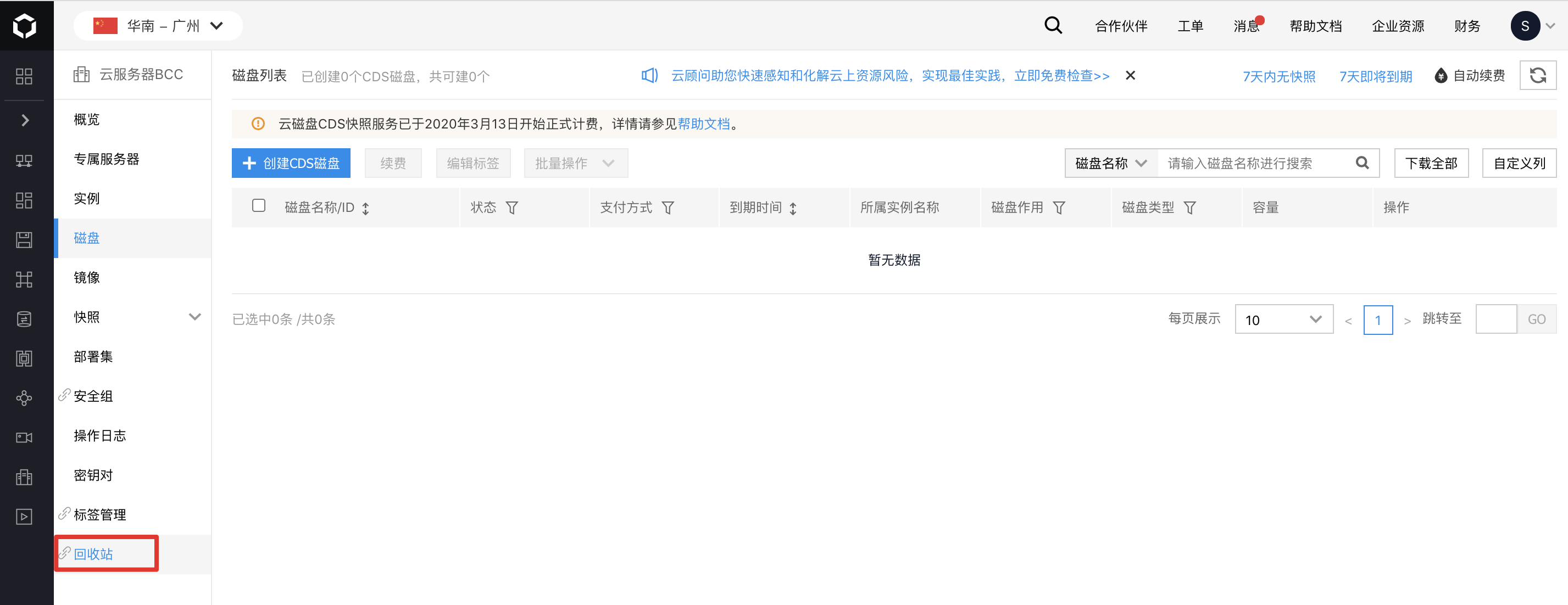
image.png

3. Resume billing

On the recycle bin page, choose CDS from the original product menu in the upper left corner, and select the region of the original disk, the date when it was moved to the recycle bin, and the original charge type.
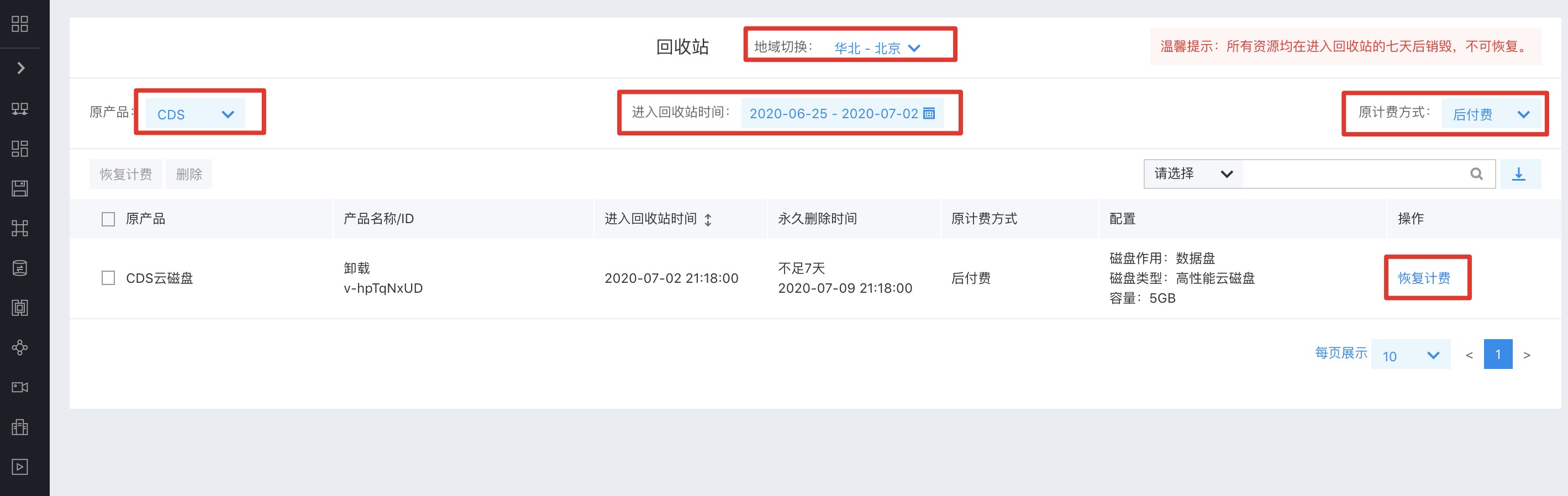
image.png

Click the "Resume Billing" button in the action bar for the cloud disk server you want to recover, then confirm the action in the pop-up window to start the billing resumption process. Once completed, the recovered cloud disk server will appear in the CDS disk list.
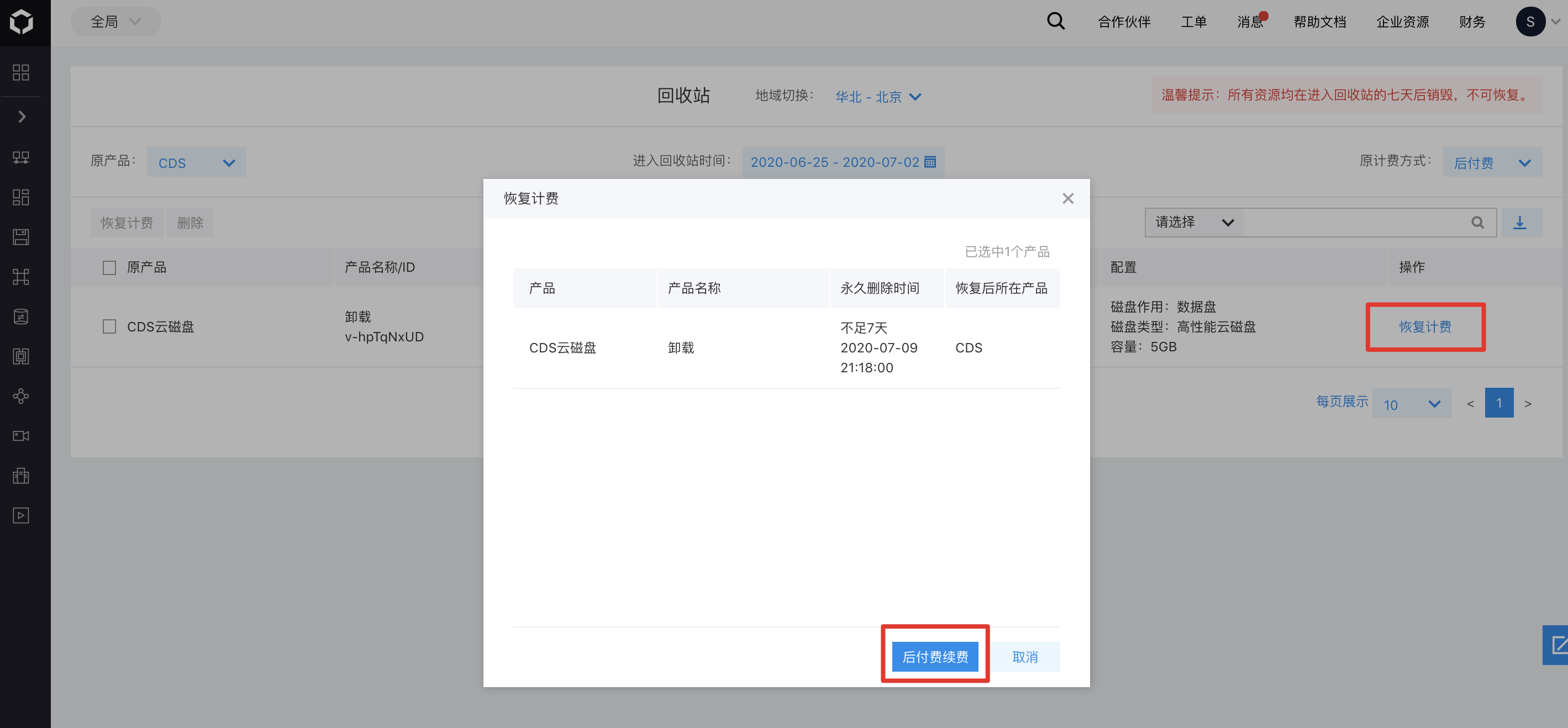
image.png

Charge

  • Disks are not charged while they are retained in the recycle bin. Normal charges only apply once you manually resume billing.

Previous
mount Cloud Disk Server
Next
Release cloud disks