Tag Management

CDS

  • API Reference
    • Disk Related Interfaces
  • Dedicated Cluster Operation Guide
    • Charge
    • Create a dedicated cluster
    • Create Cloud Disk Server in Dedicated Cluster
    • Expand Dedicated Cluster
    • View Dedicated Cluster Information
    • What Is a Dedicated Cluster
  • Disk Operation Guide
    • Basic Operations
      • Create cloud disks
      • Disk encryption
        • Encrypt Data Disk and Snapshot
        • Encrypt System Disk and Image
        • Encryption Overview
      • Format cloud disks
        • Format Disk Partition on Linux System
        • Format Disk Partition on Windows System
        • Overview
      • Monitor alarm
      • mount Cloud Disk Server
      • Recycle bin
      • Release cloud disks
      • Tag Management
      • Unmount Cloud Disk Server
    • Billing management
      • Renew cloud disks
      • Shift Charge
    • Elastic Operations
      • Burst performance capability
      • Change cloud disk type
      • Performance preconfiguration
        • Use Performance Pre-Configuration
        • What Is Performance Pre-Configuration
      • Resize cloud disks
        • Expansion Overview
        • Extend Disk Partition on Linux Data Disk
        • Extend Disk Partition on Linux System Disk
        • Extend Disk Partition on Windows Data Disk
        • Extend Disk Partition on Windows System Disk
  • FAQs
    • Billing Problems
    • Common Questions Overview
    • Configuration-related questions
    • Fault-related questions
    • Performance-related questions
    • Security Problems
  • Peripheral Tools
    • CDSCMD Tool
      • Configure CDS CMD Tool
      • Install CDS CMD Tool
      • Operate Disk Using CDS CMD Tool
      • Overview
      • Tool Version History
  • Product Description
    • Application scenarios
    • Disk Status
    • Disk types
    • Product advantages
    • Product features
    • Product functions
    • Product Introduction
    • Type and Region
  • Product pricing
    • Disk charge type
      • Pay as you go
      • Subscription billing
    • Disk Expiration and Debt Reminder
    • Snapshot Charge Type
    • Universal Storage Capacity Package GSCP
  • Product Updates
    • Function Release Records
    • Product Announcement
      • Adjustments to prepay Disk renew, shift charge, and Unsubscribe Operations
  • Service Level Agreement (SLA)
    • Baidu Intelligent Cloud Block Storage Trusted Cloud
    • CDS Service Level Agreement (SLA V2_0)
  • Snapshot Operation Guide
    • Disk Snapshot
      • Automatic snapshot
      • Create a custom image
      • Create CDS disk from snapshot
      • Cross-region replication
      • Delete a snapshot
      • Manual Snapshot
      • Snapshot Rollback
      • Tag Management
    • Instance snapshots
      • Instance snapshots
    • Introduction to snapshot
      • Instructions for use
      • Snapshot chain
  • Typical Practices
    • Block Device Persistent Naming
All documents
menu
No results found, please re-enter

CDS

  • API Reference
    • Disk Related Interfaces
  • Dedicated Cluster Operation Guide
    • Charge
    • Create a dedicated cluster
    • Create Cloud Disk Server in Dedicated Cluster
    • Expand Dedicated Cluster
    • View Dedicated Cluster Information
    • What Is a Dedicated Cluster
  • Disk Operation Guide
    • Basic Operations
      • Create cloud disks
      • Disk encryption
        • Encrypt Data Disk and Snapshot
        • Encrypt System Disk and Image
        • Encryption Overview
      • Format cloud disks
        • Format Disk Partition on Linux System
        • Format Disk Partition on Windows System
        • Overview
      • Monitor alarm
      • mount Cloud Disk Server
      • Recycle bin
      • Release cloud disks
      • Tag Management
      • Unmount Cloud Disk Server
    • Billing management
      • Renew cloud disks
      • Shift Charge
    • Elastic Operations
      • Burst performance capability
      • Change cloud disk type
      • Performance preconfiguration
        • Use Performance Pre-Configuration
        • What Is Performance Pre-Configuration
      • Resize cloud disks
        • Expansion Overview
        • Extend Disk Partition on Linux Data Disk
        • Extend Disk Partition on Linux System Disk
        • Extend Disk Partition on Windows Data Disk
        • Extend Disk Partition on Windows System Disk
  • FAQs
    • Billing Problems
    • Common Questions Overview
    • Configuration-related questions
    • Fault-related questions
    • Performance-related questions
    • Security Problems
  • Peripheral Tools
    • CDSCMD Tool
      • Configure CDS CMD Tool
      • Install CDS CMD Tool
      • Operate Disk Using CDS CMD Tool
      • Overview
      • Tool Version History
  • Product Description
    • Application scenarios
    • Disk Status
    • Disk types
    • Product advantages
    • Product features
    • Product functions
    • Product Introduction
    • Type and Region
  • Product pricing
    • Disk charge type
      • Pay as you go
      • Subscription billing
    • Disk Expiration and Debt Reminder
    • Snapshot Charge Type
    • Universal Storage Capacity Package GSCP
  • Product Updates
    • Function Release Records
    • Product Announcement
      • Adjustments to prepay Disk renew, shift charge, and Unsubscribe Operations
  • Service Level Agreement (SLA)
    • Baidu Intelligent Cloud Block Storage Trusted Cloud
    • CDS Service Level Agreement (SLA V2_0)
  • Snapshot Operation Guide
    • Disk Snapshot
      • Automatic snapshot
      • Create a custom image
      • Create CDS disk from snapshot
      • Cross-region replication
      • Delete a snapshot
      • Manual Snapshot
      • Snapshot Rollback
      • Tag Management
    • Instance snapshots
      • Instance snapshots
    • Introduction to snapshot
      • Instructions for use
      • Snapshot chain
  • Typical Practices
    • Block Device Persistent Naming
  • Document center
  • arrow
  • CDS
  • arrow
  • Disk Operation Guide
  • arrow
  • Basic Operations
  • arrow
  • Tag Management
Table of contents on this page
  • Overview
  • Add tag
  • Unbind tags
  • View the resource bill

Tag Management

Updated at:2025-11-03

Overview

Baidu AI Cloud offers a Tag Management feature, enabling efficient categorization and identification of cloud resources by assigning tags to each resource.

  • Each tag consists of a key and a value, and each tag (key + value) must be unique.
  • Supports tagging individual resources or batch-creating tags for multiple cloud resources.

Note:

  • Each user can create up to 200 tags.
  • The system disk cannot have tags added individually; you must assign tags to the BCC it belongs to. Tags for the system disk will automatically synchronize to match the tags of its parent BCC after tags are added.

Add tag

Users can tag Cloud Disk Servers (CDS) according to specific project and scenario requirements, simplifying classification, identification, and management.

Operation step:

  1. Log in to the management console and navigate to Product Services > Cloud Disk Server (CDS) to access the disk list management page.
  2. From the disk list, choose a disk and click "Edit Tag" at the top of the page.
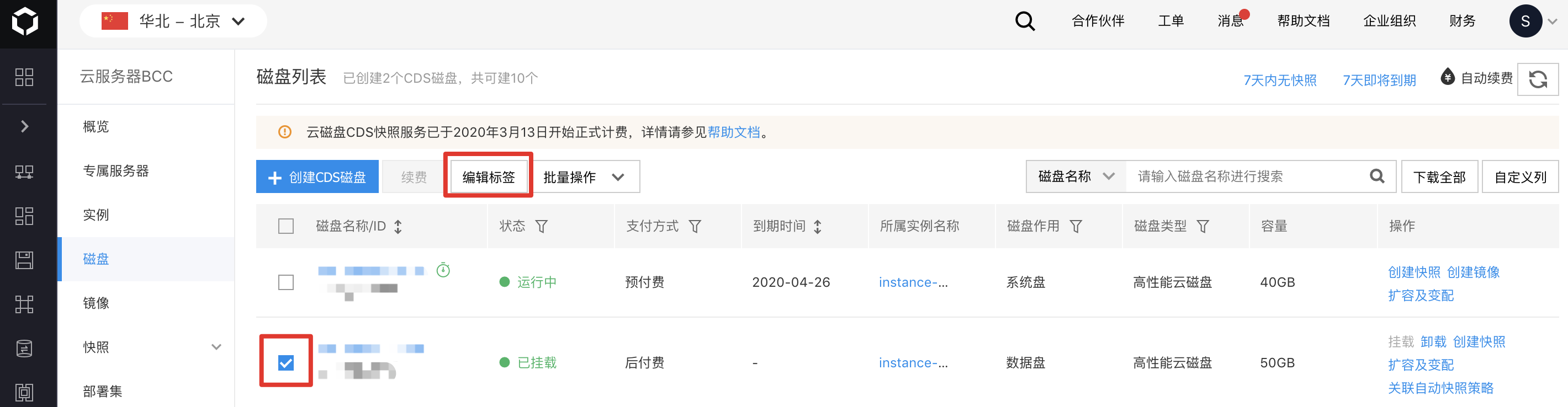
image.png

Note: Batch tag editing only allows adding tags; it cannot manage existing ones. Tag key settings are case-sensitive.

  1. In the pop-up dialog box, input a custom tag key and tag value. Each disk can have multiple tag keys, but every key needs to be unique. The value field can be left blank if needed.
  2. Click "OK" to finalize the creation of the tag.

Description:

  • To change a disk tag, you must unbind the tag first and then set it again after confirmation.

Unbind tags

If a disk no longer needs a tag, you can unbind the tag.

Operation step:

  1. Sign in to the management console, and select Product Services - Cloud Disk Server (CDS) to enter the disk list management page.
  2. In the disk list, select a disk and click Edit Tag at the top of the page.
  3. In the pop-up dialog box, click "Remove the Tag" to unbind it.
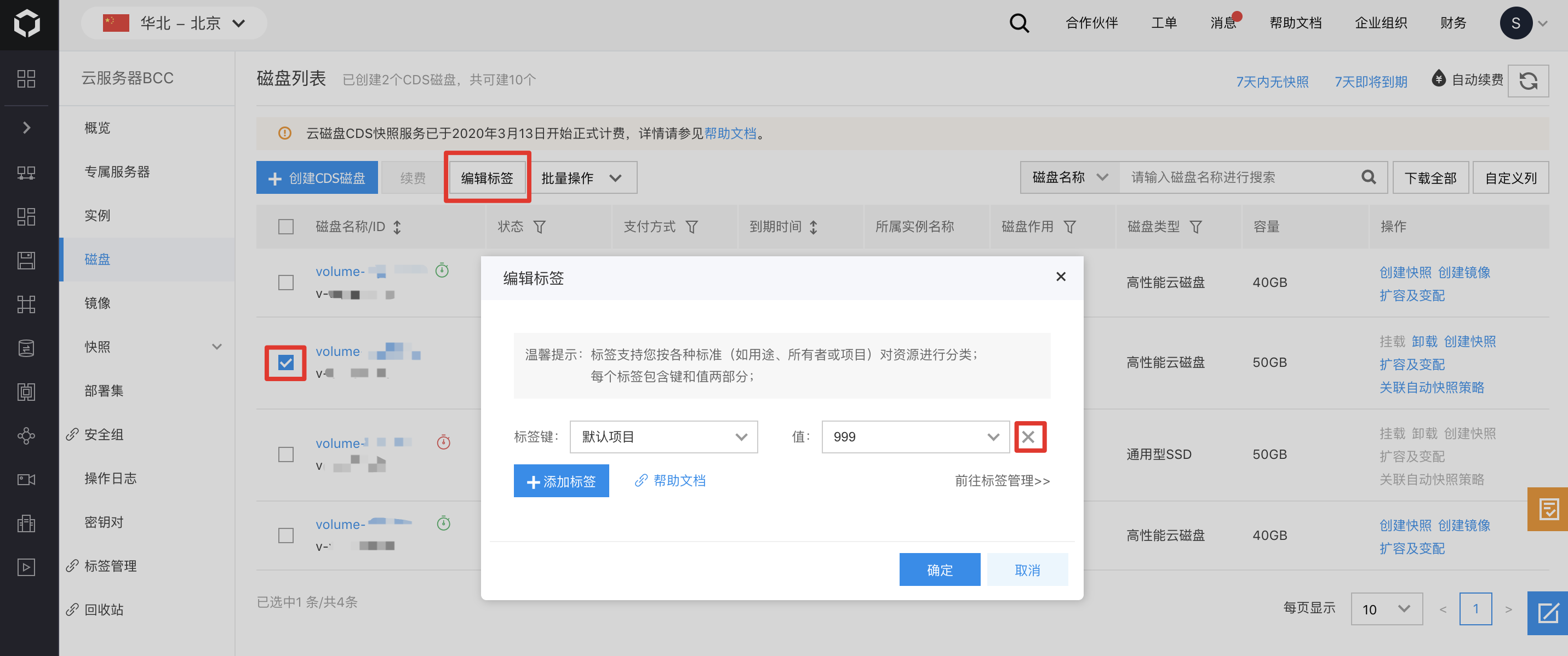
image.png

View the resource bill

The resource bill function records the lifecycle and consumption data of each resource, allowing users to view resource and product consumption data by resource dimension.

Operation step:

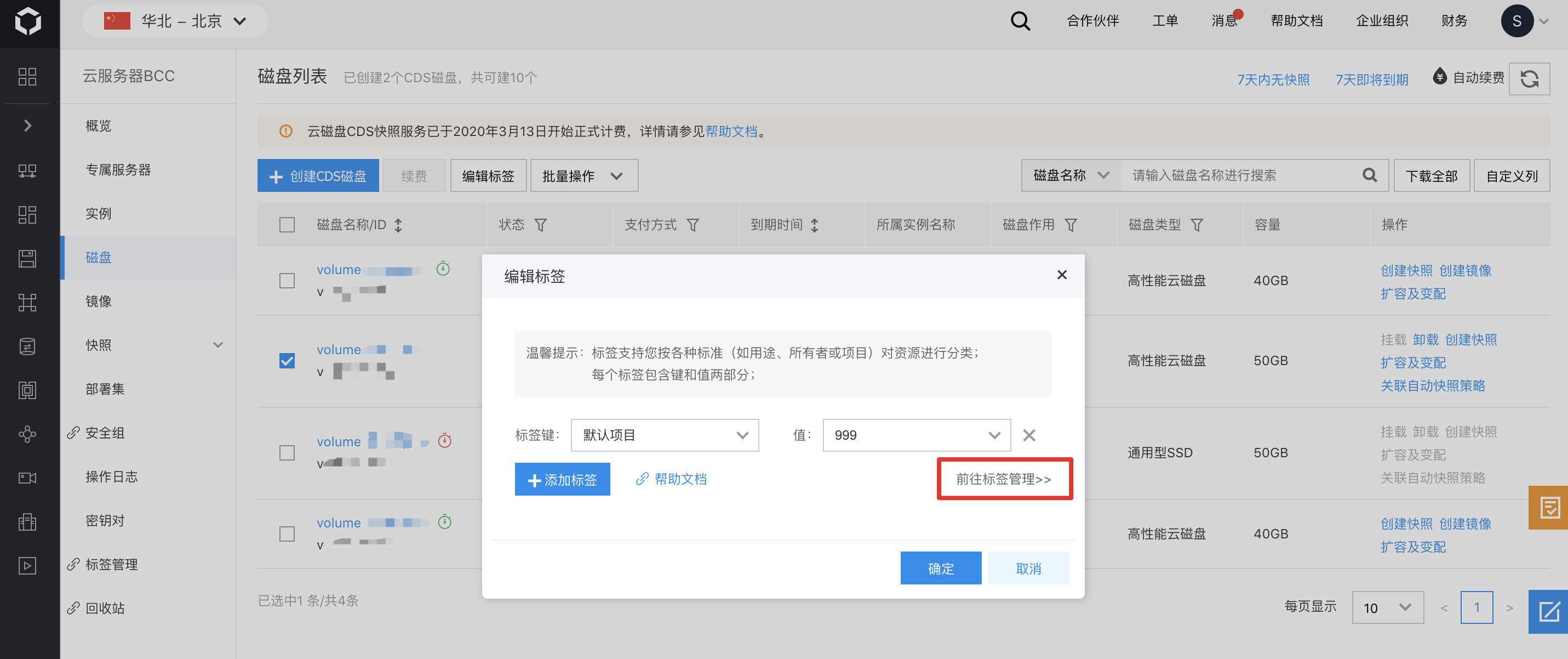
  1. Sign in to the management console, and select Product Services - Cloud Disk Server (CDS) to enter the disk list management page.
  2. In the disk list, select a disk and click Edit Tag at the top of the page.
  3. In the pop-up box, select Go to Tag Management> to enter the Baidu AI Cloud Tag Management page. image.png
  4. Click View Bill in the operation bar for binding cloud disk servers. image.png
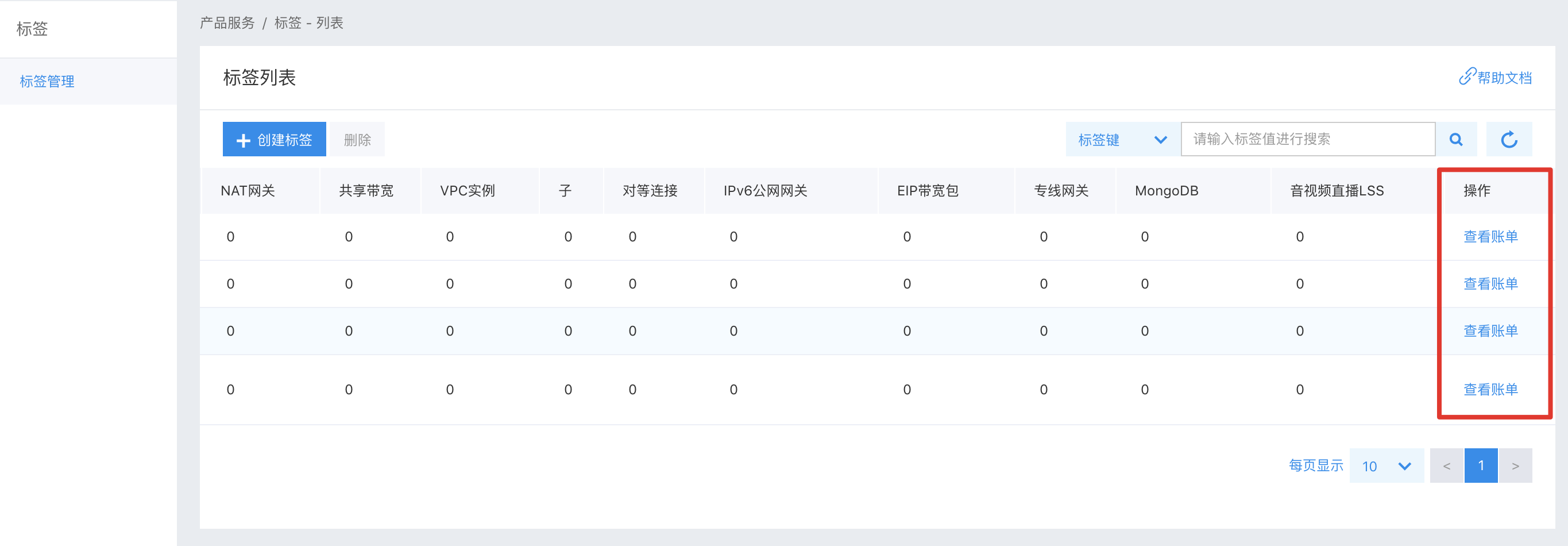
  5. Go to the Resource Bill page and select the desired month to view the bill. Current tagged resources' consumption data will be displayed. You can also search tags by combining filter criteria, view consumption details for other tags using their tag key and value, and download the related information.
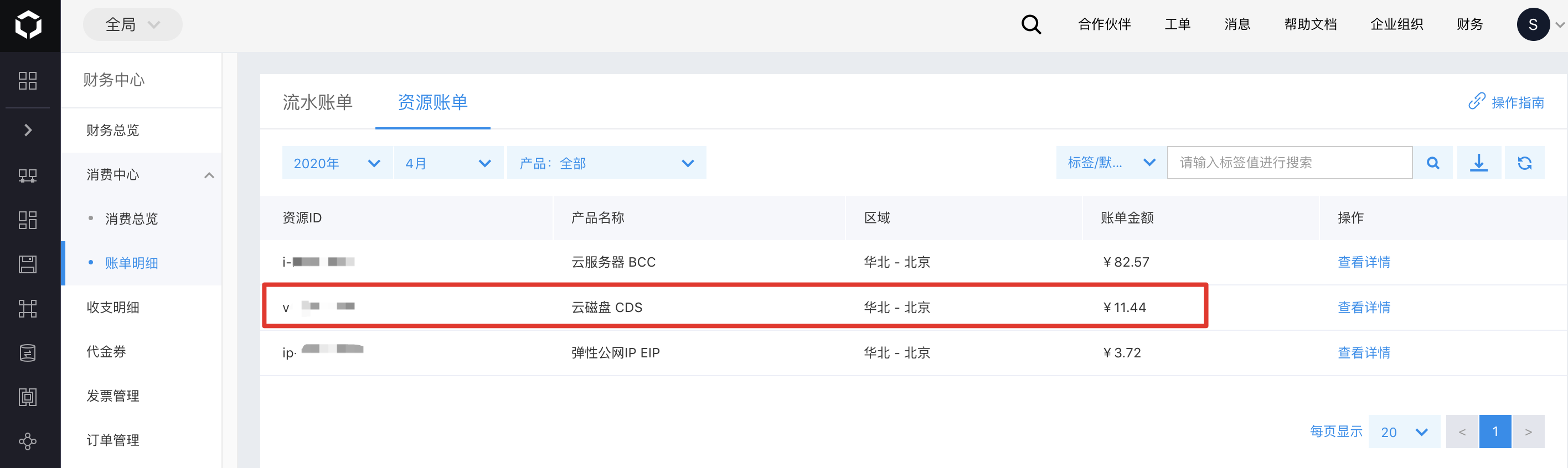
image.png

  1. Click "View Details" to see the resource ID, product name, and bill amount.

Previous
Release cloud disks
Next
Unmount Cloud Disk Server