

Introduction
What is Cloud Smart Network (CSN)
Cloud Smart Network (CSN) provides high-performance and low-latency network connections between VPCs across different regions, between VPCs and on-premises data centers, as well as between central and edge clouds. It supports capabilities such as multi-point connections throughout the entire network, automatic route learning and distribution, and optimal link selection, enabling users to build global private cloud networks with enterprise-grade scale and communication features.
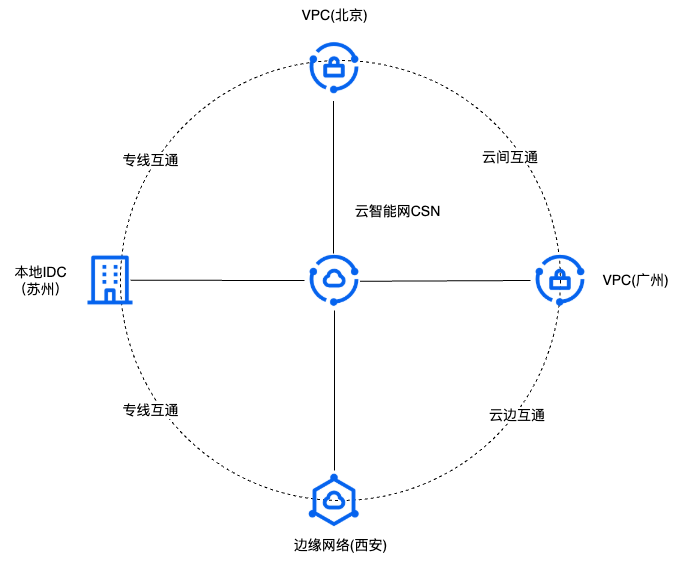
Components
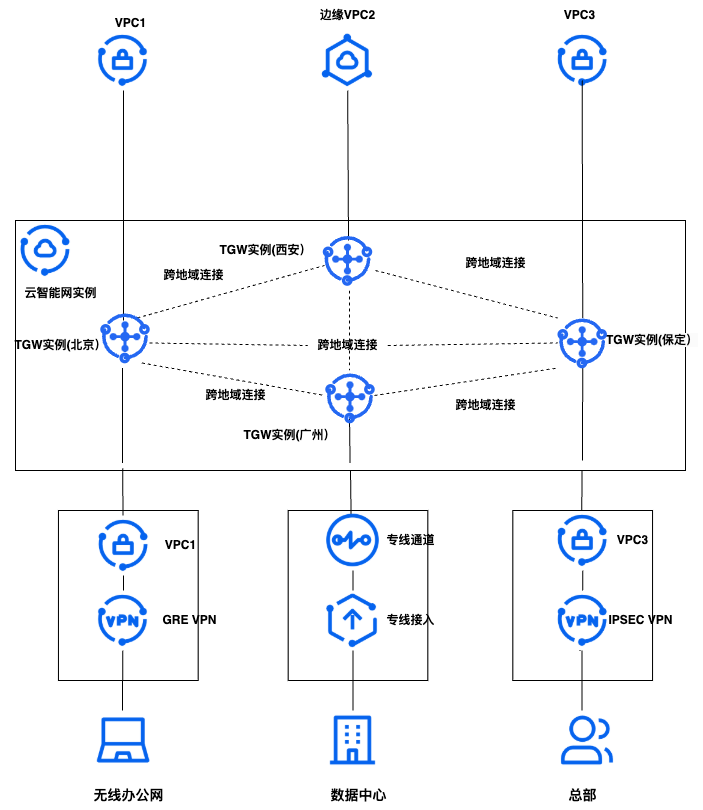
Components of Cloud Smart Network (CSN):
- CSN Instance
The CSN instance is a core resource that facilitates the management of an integrated network on a virtual private cloud.
After creating a CSN instance, load the network instances that require connection into it. All network instances are connected by default. For cross-region network instances, high-traffic connection can be achieved after purchasing bandwidth packages and configuring cross-region bandwidth. For detailed information about CSN instances, please refer to CSN Instance
- Network Instance
Refer to instances that need to achieve global connection through Cloud Smart Network (CSN). By loading them into CSN, you can realize one-point access and global connection. Types of network instance types include: virtual private cloud (VPC), dedicated channels and edge networks. For more detailed configuration instructions on network instance types, please refer to Network Instance in the operation guide
- TGW instances
Its Chinese name is Transit Gateway (TGW). In each availability zone, the CSN instance creates a TGW instance. Cloud Smart Network (CSN) connects network instances within the same availability zone using TGW instances, serving as a bridge to network instances in the same or different regions. TGW also plays a role in managing routing tables, routing policies, and cross-region connections within each region, meeting diverse networking and management needs.
- Bandwidth Package
Network instances in the same region are connected by default. For cross-region network instances, the product provides a default bandwidth of 10 Kbps. If you want to increase the bandwidth, you need to purchase a bandwidth package and configure cross-region bandwidth to achieve a higher-bandwidth connection. For details, please refer to Bandwidth Package Management
- CSN Route Table
Cloud Smart Network (CSN) automatically learns routes and adds them to the CSN route table. System routes are published to the CSN route table by default and support manual unpublishing; custom routes cannot be automatically published to the CSN route table, but you can manually add them to the CSN route table. For details, please refer to Route Management
Function comparison
Cloud Smart Network (CSN) has the following advantages:
| Advantages of Cloud Smart Network | Peering connection/dedicated channel/VPN gateway | Cloud Smart Network (CSN) |
|---|---|---|
| Full-Network chain interconnection |
|
|
| Autonomous route learning |
|
|
| Low latency and high speed |
|
|
| Low cost |
|
|
Product advantages
- Full-network Connection
Cloud Smart Network (CSN) enables users to build global virtual private clouds with enterprise-level scale and communication capabilities. Through automatic route learning and distribution, all network instances added to the CSN instance are interconnected, simplifying route management.
- Low Latency and High Speed
Cloud Smart Network (CSN) provides high-speed and low-latency network transmission. It ensures the shortest path connection between two points within the intranet, avoiding detours and congestion caused by public network routing, thereby significantly reducing latency in multi-point connections.
- Nearby Access and Intelligent Scheduling
The intelligent scheduling system of Cloud Smart Network (CSN) leverages a comprehensive multi-level network topology and unified route detection. It supports nearby access to local services and shortest-path connections.
- Simple Operation
To interconnect network instances within the same region, only two steps are needed: Create a CSN instance -> Add network instances. For high-traffic cross-region network connections, four steps are required: Create a CSN instance -> Add a network instance -> Purchase a bandwidth package -> Create a cross-region bandwidth.
- Low Cost
Interconnecting network instances within the same region is free; for high-traffic cross-region connections, you only need to purchase bandwidth based on traffic volume.
- Bandwidth Monitor
Real-time monitoring is provided for bandwidth usage, ingress/egress bandwidth, ingress/egress traffic, and other metrics on each regional link, ensuring the stability of your services.