Product Introduction

BLB BLB

  • API Reference
    • Access control
    • API Service Domain Name
    • Appendix
    • Application BLB Interface
      • Application BLB Instance Related Interfaces
      • Application BLB Listener Related Interfaces
      • Application BLB Security Group Related Interfaces
      • Application BLB Server Group Related Interfaces
    • Application IPv6 BLB Interface
      • Application IPv6 BLB Instance Related Interfaces
      • Application IPv6 BLB Listener Related Interfaces
      • Application IPv6 BLB Security Group Related Interfaces
      • Application IPv6 BLB Server Group Related Interfaces
    • BLB Order Related Interfaces
      • BLB - Resize
      • BLB Charge Shift - Cancel Prepay to Postpay
      • BLB Charge Shift - Postpay to Prepay
      • BLB Charge Shift - Prepay to Postpay
      • BLB Inquiry
      • BLB Unsubscribe Interface
    • Document Update Records
    • Error code
    • Interface Specifications
    • Introduction
    • Load Balancer Dedicated Cluster LBDC Interface
      • LBDC Instance Related Interfaces
    • Service Publishing Point Interface
      • Service Publishing Point Related Interfaces
    • Standard BLB Interface
      • Standard BLB Instance Related Interfaces
      • Standard BLB Listener Related Interfaces
      • Standard BLB Real Server Related Interfaces
      • Standard BLB Security Group Related Interfaces
    • Standard IPv6 BLB Interface
      • Standard IPv6 BLB Related Interfaces
  • FAQs
    • Billing Problems
    • Common Questions Overview
    • Configuration-related questions
    • Fault-related questions
    • General Problems
    • Load Balancer Dedicated Cluster Related Issues
    • Performance-related questions
    • Security Problems
  • Function Release Records
  • Operation guide
    • Access control
    • Access Logs
    • Application BLB instance
    • Application IPv6 Instance
    • BLB metric description
    • Certification
    • Custom configuration
    • Extended domain name
    • General-purpose BLB instance
      • Creating BLB Ordinary Instance
      • Managing BLB Ordinary Instance
    • General-purpose IPv6 BLB instance
    • Identity and access management
    • IP Group Usage Guide
    • Load Balance Dedicated Cluster
    • Load Balancer Frontend and Backend Protocol Correspondence
    • Recording Access Logs Using VPC Flow Logs
    • Service Release Point
    • Tag Management
  • Product Description
    • Application scenarios
    • Basic Architecture
    • Basic concepts
    • Performance Specification Description
    • Product advantages
    • Product features
    • Product Introduction
    • Usage restrictions
  • Product pricing
    • Load Balancer Dedicated Cluster Billing
    • Load Balancer Instance Billing
  • Quick Start
  • SDK
    • GO-SDK
      • Application BLB Instance
      • Initialization
      • Install
      • IPv6 BLB Instance
      • Load Balance Dedicated Cluster (LBDC)
      • Ordinary BLB Instance
      • Overview
      • Service Release Point
      • Version Change Records
    • Java-SDK
      • Application BLB instance
      • General-purpose BLB instance
      • Initialization
      • Install the SDK Package
      • IPv6 BLB Instance
      • Load Balance Dedicated Cluster (LBDC)
      • Overview
      • Service Release Point
      • Version Update Description
    • PHP-SDK
      • Initialization
      • Install
      • Ordinary BLB Instance
      • Overview
    • Python-SDK
      • Application BLB Instance
      • Initialization
      • Install
      • IPv6 BLB Instance
      • Load Balance Dedicated Cluster (LBDC)
      • Ordinary BLB Instance
      • Overview
      • Service Release Point
      • Version Update Description
  • Service Level Agreement (SLA)
    • Description of Baidu AI Cloud Load Balancer Trusted Cloud certification service availability
    • LBDC Service Level Agreement SLA
    • BLB Service Level Agreement (V2.0)
  • Typical Practices
    • BLB Selection Guide
    • Health Check Exception Troubleshooting
    • Implementing BLB Association with Listeners, Real Servers, Security Groups, etc. via Terraform
    • Implementing Multi-Site Hosting via Application BLB
    • Load Balancer Security Protection Strategy
    • Managing BLB via Terraform
    • Obtaining Client Information via Application BLB Instance
    • Using IP Group Function to Mount Real Servers Across VPCs in Different Regions
    • Using IP Group Function to Mount Real Servers Across VPCs in the Same Region
All documents
menu
No results found, please re-enter

BLB BLB

  • API Reference
    • Access control
    • API Service Domain Name
    • Appendix
    • Application BLB Interface
      • Application BLB Instance Related Interfaces
      • Application BLB Listener Related Interfaces
      • Application BLB Security Group Related Interfaces
      • Application BLB Server Group Related Interfaces
    • Application IPv6 BLB Interface
      • Application IPv6 BLB Instance Related Interfaces
      • Application IPv6 BLB Listener Related Interfaces
      • Application IPv6 BLB Security Group Related Interfaces
      • Application IPv6 BLB Server Group Related Interfaces
    • BLB Order Related Interfaces
      • BLB - Resize
      • BLB Charge Shift - Cancel Prepay to Postpay
      • BLB Charge Shift - Postpay to Prepay
      • BLB Charge Shift - Prepay to Postpay
      • BLB Inquiry
      • BLB Unsubscribe Interface
    • Document Update Records
    • Error code
    • Interface Specifications
    • Introduction
    • Load Balancer Dedicated Cluster LBDC Interface
      • LBDC Instance Related Interfaces
    • Service Publishing Point Interface
      • Service Publishing Point Related Interfaces
    • Standard BLB Interface
      • Standard BLB Instance Related Interfaces
      • Standard BLB Listener Related Interfaces
      • Standard BLB Real Server Related Interfaces
      • Standard BLB Security Group Related Interfaces
    • Standard IPv6 BLB Interface
      • Standard IPv6 BLB Related Interfaces
  • FAQs
    • Billing Problems
    • Common Questions Overview
    • Configuration-related questions
    • Fault-related questions
    • General Problems
    • Load Balancer Dedicated Cluster Related Issues
    • Performance-related questions
    • Security Problems
  • Function Release Records
  • Operation guide
    • Access control
    • Access Logs
    • Application BLB instance
    • Application IPv6 Instance
    • BLB metric description
    • Certification
    • Custom configuration
    • Extended domain name
    • General-purpose BLB instance
      • Creating BLB Ordinary Instance
      • Managing BLB Ordinary Instance
    • General-purpose IPv6 BLB instance
    • Identity and access management
    • IP Group Usage Guide
    • Load Balance Dedicated Cluster
    • Load Balancer Frontend and Backend Protocol Correspondence
    • Recording Access Logs Using VPC Flow Logs
    • Service Release Point
    • Tag Management
  • Product Description
    • Application scenarios
    • Basic Architecture
    • Basic concepts
    • Performance Specification Description
    • Product advantages
    • Product features
    • Product Introduction
    • Usage restrictions
  • Product pricing
    • Load Balancer Dedicated Cluster Billing
    • Load Balancer Instance Billing
  • Quick Start
  • SDK
    • GO-SDK
      • Application BLB Instance
      • Initialization
      • Install
      • IPv6 BLB Instance
      • Load Balance Dedicated Cluster (LBDC)
      • Ordinary BLB Instance
      • Overview
      • Service Release Point
      • Version Change Records
    • Java-SDK
      • Application BLB instance
      • General-purpose BLB instance
      • Initialization
      • Install the SDK Package
      • IPv6 BLB Instance
      • Load Balance Dedicated Cluster (LBDC)
      • Overview
      • Service Release Point
      • Version Update Description
    • PHP-SDK
      • Initialization
      • Install
      • Ordinary BLB Instance
      • Overview
    • Python-SDK
      • Application BLB Instance
      • Initialization
      • Install
      • IPv6 BLB Instance
      • Load Balance Dedicated Cluster (LBDC)
      • Ordinary BLB Instance
      • Overview
      • Service Release Point
      • Version Update Description
  • Service Level Agreement (SLA)
    • Description of Baidu AI Cloud Load Balancer Trusted Cloud certification service availability
    • LBDC Service Level Agreement SLA
    • BLB Service Level Agreement (V2.0)
  • Typical Practices
    • BLB Selection Guide
    • Health Check Exception Troubleshooting
    • Implementing BLB Association with Listeners, Real Servers, Security Groups, etc. via Terraform
    • Implementing Multi-Site Hosting via Application BLB
    • Load Balancer Security Protection Strategy
    • Managing BLB via Terraform
    • Obtaining Client Information via Application BLB Instance
    • Using IP Group Function to Mount Real Servers Across VPCs in Different Regions
    • Using IP Group Function to Mount Real Servers Across VPCs in the Same Region
  • Document center
  • arrow
  • BLBBLB
  • arrow
  • Product Description
  • arrow
  • Product Introduction
Table of contents on this page
  • Load Balancer Instance
  • Load Balance Dedicated Cluster

Product Introduction

Updated at:2025-10-16

Load Balancer Instance

Baidu Load Balance (BLB) consolidates multiple Baidu Cloud Computes within the same region into a group, assigns an intranet or Internet service address, and distributes concurrent front-end requests across multiple real cloud servers. This balances application traffic, facilitates horizontal scaling of service performance, and enhances availability by automatically resolving single points of failure.

It now launches application BLB instance, and its features the following deployment architecture in a specific scenario:
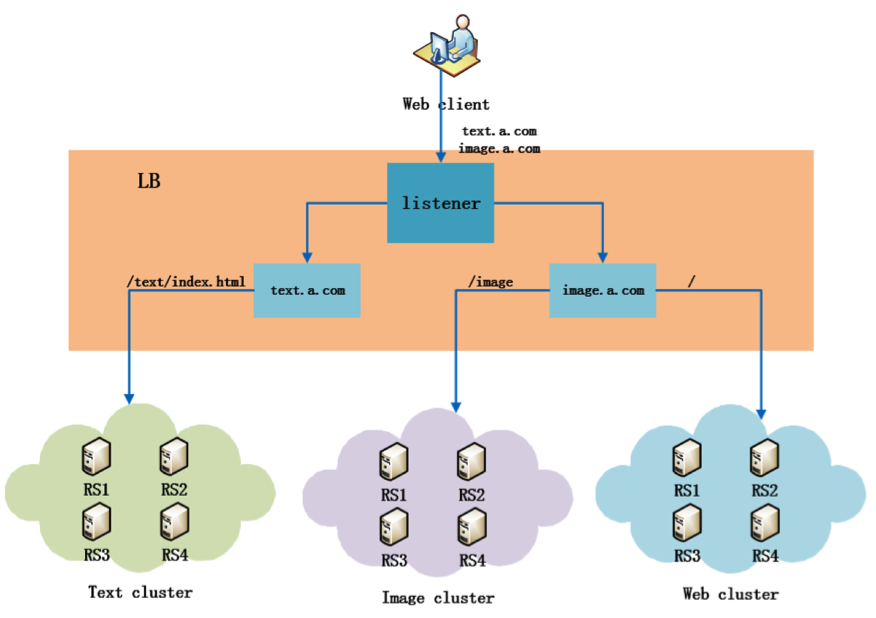
Instance type comparison:

Instance type Description Differences
General-purpose BLB The service includes standard load balancer components, such as listeners and real servers, to address general load balancing needs. It supports the distribution of IPv4 or IPv6 traffic from the Internet or intranet to multiple IPv4 real servers using specific load balancing protocols, offering a lightweight, straightforward, and cost-effective solution. Real servers are organized by instance dimension. Each listener can forward to all real servers of the instance, with identical real ports for corresponding listeners.
Traffic forwarding methods: Unified listener scheduling supports weighted round-robin, weighted least connections, and traffic forwarding based on source IP.
Application BLB The service is designed for complex application deployments, particularly large-scale websites. By employing a policy-based traffic forwarding framework, it can distribute IPv4 or IPv6 traffic from the Internet or intranet to various IPv4 real server groups based on predefined strategies, achieving service-oriented traffic load balancing. It supports server groups, allows the organization of real servers by listener dimension. Each listener can correspond to different real server groups via policies. The IP group scenario supports setting different real ports for servers within the same server group.
Traffic forwarding method: Policy-based forwarding by domain name/URL/source IP/Cookie; policy-based weight setting also supported.
General-purpose IPv6 BLB It incorporates standard load balancer features, such as listeners and real servers, to address users' general load balancing demands. The service supports the distribution of IPv6 traffic from the Internet or intranet to multiple IPv6 real servers using specific load balancing protocols, ensuring a lightweight design and straightforward setup. Real servers are organized by instance dimension. Each listener can forward to all real servers of the instance, with identical real ports for corresponding listeners.
Traffic forwarding methods: Unified listener scheduling supports weighted round-robin, weighted least connections, and traffic forwarding based on source IP. Only support distributing front-end IPv6 traffic to IPv6 real servers.
Application IPv6 BLB Tailored for complex application deployments, particularly for large-scale websites, this service uses a policy-driven traffic forwarding framework to route IPv6 traffic from the Internet or intranet to multiple IPv6 real server groups based on relevant strategies, enabling efficient service-based traffic load balancing. It supports server groups, allows the organization of real servers by listener dimension. Each listener can correspond to different real server groups via policies. The IP group scenario supports setting different real ports for servers within the same server group.
Traffic forwarding method: Policy-based forwarding by domain name/URL/source IP/Cookie; policy-based weight setting also supported. Only support distributing front-end IPv6 traffic to IPv6 real servers.

Specification comparison:

Instance specification. Performance limit
Standard 1 Concurrent connections: 50,000; new connections per second: 5,000; queries-per-second: 5,000; bandwidth limit: 1Gbps
Standard 2 Concurrent connections: 100,000; new connections per second: 10,000; queries-per-second: 10,000; bandwidth limit: 2Gbps
Enhance 1 Concurrent connections: 200,000; new connections per second: 20,000; queries-per-second: 20,000; bandwidth limit: 4Gbps
Enhance 2 Concurrent connections: 500,000; new connections per second: 50,000; queries-per-second: 30,000; bandwidth limit: 6Gbps
Ultra Large 1 Concurrent connections: 1,000,000; new connections per second: 100,000; queries-per-second: 50,000; bandwidth limit: 10Gbps
Ultra Large 2 Concurrent connections: 2,000,000; new connections per second: 200,000; queries-per-second: 100,000; bandwidth limit: 20Gbps
Ultra Large 3 Concurrent connections: 4,000,000; new connections per second: 400,000; queries-per-second: 200,000; bandwidth limit: 40Gbps
Ultra Large 4 Concurrent connections: 6,000,000; new connections per second: 600,000; queries-per-second: 300,000; bandwidth limit: 60Gbps
Ultra Large 5 Concurrent connections: 8,000,000; new connections per second: 800,000; queries-per-second: 800,000; bandwidth limit: 80Gbps

Load Balance Dedicated Cluster

Load Balance Dedicated Cluster facilitates the deployment of load balancer instances within dedicated clusters, ensuring controlled performance, exclusive resource allocation, and physical isolation. This service caters to users requiring ultra-high performance and exclusive resources.

Notes If a user doesn't purchase a Load Balance Dedicated Cluster, BLB instances he/she created are located in a shared cluster by default, where instance performance is shared by multiple tenants. Performance may be constrained during resource contention. If the user requires ultra-high performance and exclusive resources, we recommended that you use a Load Balance Dedicated Cluster.

Difference between load balance dedicated clusters and shared clusters:

Comparison items Description Dedicated cluster Shared cluster
Dedicated configuration Dedicated special service requirement configuration Support Not supported
Traffic isolation Traffic isolation from other users' services Support Not supported
Precise traffic routing Precisely routes service traffic to this cluster Support Not supported
Service isolation Deployment isolation from other users' services Support Not supported
Cluster performance Overall cluster performance limit Support specifying performance specifications and one-click scale-up and dilatation A limit is set for the cluster performance; multiple users compete for resources when encountering performance bottlenecks.
Cluster monitoring Monitor service load at the cluster granularity Support Not supported
Associated instances Support viewing all instances on the cluster Support Not supported
Price Charged by cluster in prepay mode; BLB instances will no longer be charged. BLB configuration fee is charged only

Previous
Product features
Next
Usage restrictions