VPC网络PLAINTEXT方式生产和消费
更新时间:2025-08-21
在同 VPC 网络下访问,使用 PLAINTEXT 协议接入,接入点可以在 集群详情 页面查看。
环境准备
- 安装GCC
- 安装C++ 依赖库。
Shell
1yum install librdkafka-devel
2yum install cyrus-sasl
3yum install cyrus-sasl-scram
集群准备
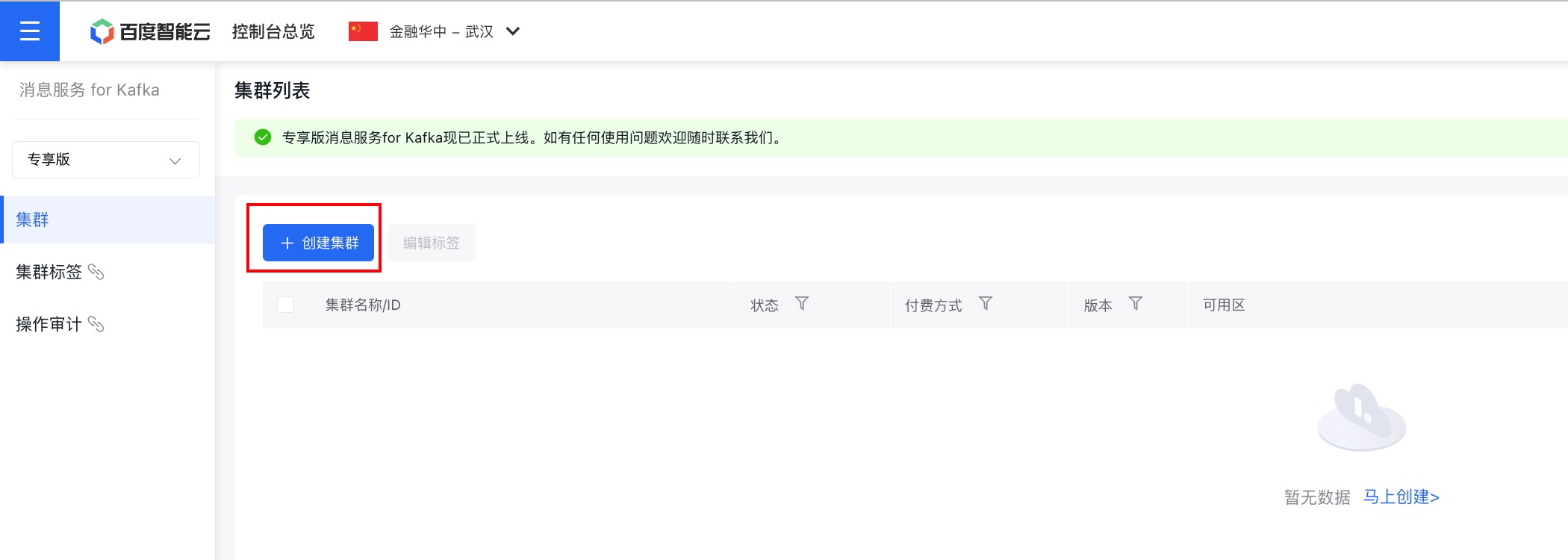
1. 购买专享版消息服务for Kafka集群
开通消息服务 for Kafka服务后,在控制台页面点击『创建集群』,即可进行购买。
2. 为购买的集群创建主题
在控制台页面点击集群名称,进入集群详情页面。
在左侧的边栏中点击『主题管理』,进入主题管理页面。
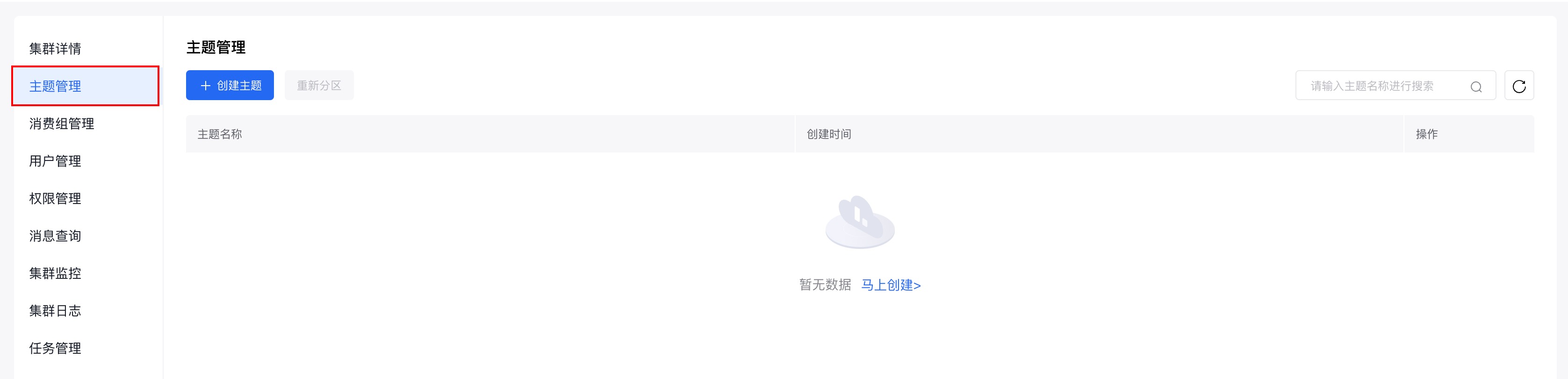
在主题管理页面点击『创建主题』,进行主题的创建。
使用步骤:
步骤一:获取集群接入点
具体请参考:接入点查看。
步骤二:编写测试代码
生产者代码示例
创建KafkaProducerDemo.c文件,具体代码示例如下:
Shell
1/*
2* librdkafka - Apache Kafka C library
3*
4* Copyright (c) 2017, Magnus Edenhill
5* All rights reserved.
6*
7* Redistribution and use in source and binary forms, with or without
8* modification, are permitted provided that the following conditions are met:
9*
10* 1. Redistributions of source code must retain the above copyright notice,
11*    this list of conditions and the following disclaimer.
12* 2. Redistributions in binary form must reproduce the above copyright notice,
13*    this list of conditions and the following disclaimer in the documentation
14*    and/or other materials provided with the distribution.
15*
16* THIS SOFTWARE IS PROVIDED BY THE COPYRIGHT HOLDERS AND CONTRIBUTORS "AS IS"
17* AND ANY EXPRESS OR IMPLIED WARRANTIES, INCLUDING, BUT NOT LIMITED TO, THE
18* IMPLIED WARRANTIES OF MERCHANTABILITY AND FITNESS FOR A PARTICULAR PURPOSE
19* ARE DISCLAIMED. IN NO EVENT SHALL THE COPYRIGHT OWNER OR CONTRIBUTORS BE
20* LIABLE FOR ANY DIRECT, INDIRECT, INCIDENTAL, SPECIAL, EXEMPLARY, OR
21* CONSEQUENTIAL DAMAGES (INCLUDING, BUT NOT LIMITED TO, PROCUREMENT OF
22* SUBSTITUTE GOODS OR SERVICES; LOSS OF USE, DATA, OR PROFITS; OR BUSINESS
23* INTERRUPTION) HOWEVER CAUSED AND ON ANY THEORY OF LIABILITY, WHETHER IN
24* CONTRACT, STRICT LIABILITY, OR TORT (INCLUDING NEGLIGENCE OR OTHERWISE)
25* ARISING IN ANY WAY OUT OF THE USE OF THIS SOFTWARE, EVEN IF ADVISED OF THE
26* POSSIBILITY OF SUCH DAMAGE.
27  */
28
29/**
30* Simple Apache Kafka producer
31* using the Kafka driver from librdkafka
32* (https://github.com/edenhill/librdkafka)
33  */
34
35#include <stdio.h>
36#include <signal.h>
37#include <string.h>
38
39
40/* Typical include path would be <librdkafka/rdkafka.h>, but this program
41* is builtin from within the librdkafka source tree and thus differs. */
42  #include "librdkafka/rdkafka.h"
43
44
45static volatile sig_atomic_t run = 1;
46
47/**
48* @brief Signal termination of program
49  */
50  static void stop(int sig) {
51  run = 0;
52  fclose(stdin); /* abort fgets() */
53  }
54
55
56/**
57* @brief Message delivery report callback.
58*
59* This callback is called exactly once per message, indicating if
60* the message was succesfully delivered
61* (rkmessage->err == RD_KAFKA_RESP_ERR_NO_ERROR) or permanently
62* failed delivery (rkmessage->err != RD_KAFKA_RESP_ERR_NO_ERROR).
63*
64* The callback is triggered from rd_kafka_poll() and executes on
65* the application's thread.
66  */
67  static void dr_msg_cb(rd_kafka_t *rk, const rd_kafka_message_t *rkmessage, void *opaque) {
68  if (rkmessage->err) {
69  fprintf(stderr, "%% Message delivery failed: %s\n", rd_kafka_err2str(rkmessage->err));
70  } else {
71  fprintf(stderr, "%% Message delivered (%zd bytes, partition %" PRId32 ")\n", rkmessage->len, rkmessage->partition);
72  }
73
74  /* The rkmessage is destroyed automatically by librdkafka */
75  }
76
77
78
79int main(int argc, char **argv) {
80rd_kafka_t *rk;        /* Producer instance handle */
81rd_kafka_conf_t *conf; /* Temporary configuration object */
82
83    char errstr[512];      /* librdkafka API error reporting buffer */
84    char buf[512];         /* Message value temporary buffer */
85
86    const char *brokers;   /* Argument: broker list */
87    const char *topic;     /* Argument: topic to produce to */
88    // const char *username;      /* Argument: sasl username */
89    // const char *password;      /* Argument: sasl password */
90
91    /*
92     * Argument validation
93     */
94
95     // 检查参数配置
96    if (argc != 3) {
97        fprintf(stderr, "%% Usage: %s <broker> <topic>\n", argv[0]);
98        return 1;
99    }
100
101    // 接入点信息
102    brokers = argv[1];
103    // 主题名称
104    topic   = argv[2];
105
106
107    /*
108     * Create Kafka client configuration place-holder
109     */
110    conf = rd_kafka_conf_new();
111
112    /* Set bootstrap broker(s) as a comma-separated list of
113     * host or host:port (default port 9092).
114     * librdkafka will use the bootstrap brokers to acquire the full
115     * set of brokers from the cluster. */
116    if (rd_kafka_conf_set(conf, "bootstrap.servers", brokers, errstr, sizeof(errstr)) != RD_KAFKA_CONF_OK) {
117        fprintf(stderr, "%s\n", errstr);
118        return 1;
119    }
120
121    if (
122            rd_kafka_conf_set(conf, "security.protocol", "plaintext", errstr, sizeof(errstr)) != RD_KAFKA_CONF_OK
123    ) {
124        fprintf(stderr, "%s\n", errstr);
125        return -1;
126    }
127
128    /* Set the delivery report callback.
129     * This callback will be called once per message to inform
130     * the application if delivery succeeded or failed.
131     * See dr_msg_cb() above.
132     * The callback is only triggered from rd_kafka_poll() and
133     * rd_kafka_flush(). */
134    rd_kafka_conf_set_dr_msg_cb(conf, dr_msg_cb);
135
136    /*
137     * Create producer instance.
138     *
139     * NOTE: rd_kafka_new() takes ownership of the conf object
140     *       and the application must not reference it again after
141     *       this call.
142     */
143
144    rk = rd_kafka_new(RD_KAFKA_PRODUCER, conf, errstr, sizeof(errstr));
145    if (!rk) {
146        fprintf(stderr, "%% Failed to create new producer: %s\n", errstr);
147        return 1;
148    }
149
150    /* Signal handler for clean shutdown */
151    signal(SIGINT, stop);
152
153    fprintf(stderr,
154            "%% Type some text and hit enter to produce message\n"
155            "%% Or just hit enter to only serve delivery reports\n"
156            "%% Press Ctrl-C or Ctrl-D to exit\n");
157
158    while (run && fgets(buf, sizeof(buf), stdin)) {
159        size_t len = strlen(buf);
160        rd_kafka_resp_err_t err;
161
162        /* Remove newline */
163        if (buf[len - 1] == '\n') {
164            buf[--len] = '\0';
165        }
166
167        /* Empty line: only serve delivery reports */
168        if (len == 0) {
169            rd_kafka_poll(rk, 0/*non-blocking */);
170            continue;
171        }
172
173        /*
174         * Send/Produce message.
175         * This is an asynchronous call, on success it will only
176         * enqueue the message on the internal producer queue.
177         * The actual delivery attempts to the broker are handled
178         * by background threads.
179         * The previously registered delivery report callback
180         * (dr_msg_cb) is used to signal back to the application
181         * when the message has been delivered (or failed).
182         */
183    retry:
184        err = rd_kafka_producev(
185            /* Producer handle */
186            rk,
187            /* Topic name */
188            RD_KAFKA_V_TOPIC(topic),
189            /* Make a copy of the payload. */
190            RD_KAFKA_V_MSGFLAGS(RD_KAFKA_MSG_F_COPY),
191            /* Message value and length */
192            RD_KAFKA_V_VALUE(buf, len),
193            /* Per-Message opaque, provided in
194             * delivery report callback as
195             * msg_opaque. */
196            RD_KAFKA_V_OPAQUE(NULL),
197            /* End sentinel */
198            RD_KAFKA_V_END
199        );
200
201        if (err) {
202            /*
203             * Failed to *enqueue* message for producing.
204             */
205            fprintf(stderr,
206                    "%% Failed to produce to topic %s: %s\n", topic,
207                    rd_kafka_err2str(err));
208
209            if (err == RD_KAFKA_RESP_ERR__QUEUE_FULL) {
210                /* If the internal queue is full, wait for
211                 * messages to be delivered and then retry.
212                 * The internal queue represents both
213                 * messages to be sent and messages that have
214                 * been sent or failed, awaiting their
215                 * delivery report callback to be called.
216                 *
217                 * The internal queue is limited by the
218                 * configuration property
219                 * queue.buffering.max.messages */
220                rd_kafka_poll(rk, 1000 /*block for max 1000ms*/);
221                goto retry;
222            }
223        } else {
224            fprintf(stderr, "%% Enqueued message (%zd bytes) "
225                    "for topic %s\n",
226                    len, topic);
227        }
228
229
230        /* A producer application should continually serve
231         * the delivery report queue by calling rd_kafka_poll()
232         * at frequent intervals.
233         * Either put the poll call in your main loop, or in a
234         * dedicated thread, or call it after every
235         * rd_kafka_produce() call.
236         * Just make sure that rd_kafka_poll() is still called
237         * during periods where you are not producing any messages
238         * to make sure previously produced messages have their
239         * delivery report callback served (and any other callbacks
240         * you register). */
241        rd_kafka_poll(rk, 0 /*non-blocking*/);
242    }
243
244
245    /* Wait for final messages to be delivered or fail.
246     * rd_kafka_flush() is an abstraction over rd_kafka_poll() which
247     * waits for all messages to be delivered. */
248    fprintf(stderr, "%% Flushing final messages..\n");
249    rd_kafka_flush(rk, 10 * 1000 /* wait for max 10 seconds */);
250
251    /* If the output queue is still not empty there is an issue
252     * with producing messages to the clusters. */
253    if (rd_kafka_outq_len(rk) > 0) {
254        fprintf(stderr, "%% %d message(s) were not delivered\n", rd_kafka_outq_len(rk));
255    }
256
257    /* Destroy the producer instance */
258    rd_kafka_destroy(rk);
259
260    return 0;
261}
消费者代码示例
创建KafkaConsumerDemo.c文件,具体代码示例如下:
Shell
1/*
2* librdkafka - Apache Kafka C library
3*
4* Copyright (c) 2019, Magnus Edenhill
5* All rights reserved.
6*
7* Redistribution and use in source and binary forms, with or without
8* modification, are permitted provided that the following conditions are met:
9*
10* 1. Redistributions of source code must retain the above copyright notice,
11*    this list of conditions and the following disclaimer.
12* 2. Redistributions in binary form must reproduce the above copyright notice,
13*    this list of conditions and the following disclaimer in the documentation
14*    and/or other materials provided with the distribution.
15*
16* THIS SOFTWARE IS PROVIDED BY THE COPYRIGHT HOLDERS AND CONTRIBUTORS "AS IS"
17* AND ANY EXPRESS OR IMPLIED WARRANTIES, INCLUDING, BUT NOT LIMITED TO, THE
18* IMPLIED WARRANTIES OF MERCHANTABILITY AND FITNESS FOR A PARTICULAR PURPOSE
19* ARE DISCLAIMED. IN NO EVENT SHALL THE COPYRIGHT OWNER OR CONTRIBUTORS BE
20* LIABLE FOR ANY DIRECT, INDIRECT, INCIDENTAL, SPECIAL, EXEMPLARY, OR
21* CONSEQUENTIAL DAMAGES (INCLUDING, BUT NOT LIMITED TO, PROCUREMENT OF
22* SUBSTITUTE GOODS OR SERVICES; LOSS OF USE, DATA, OR PROFITS; OR BUSINESS
23* INTERRUPTION) HOWEVER CAUSED AND ON ANY THEORY OF LIABILITY, WHETHER IN
24* CONTRACT, STRICT LIABILITY, OR TORT (INCLUDING NEGLIGENCE OR OTHERWISE)
25* ARISING IN ANY WAY OUT OF THE USE OF THIS SOFTWARE, EVEN IF ADVISED OF THE
26* POSSIBILITY OF SUCH DAMAGE.
27  */
28
29/**
30* Simple high-level balanced Apache Kafka consumer
31* using the Kafka driver from librdkafka
32* (https://github.com/edenhill/librdkafka)
33  */
34
35#include <stdio.h>
36#include <signal.h>
37#include <string.h>
38#include <ctype.h>
39
40
41/* Typical include path would be <librdkafka/rdkafka.h>, but this program
42* is builtin from within the librdkafka source tree and thus differs. */
43  //#include <librdkafka/rdkafka.h>
44  #include "librdkafka/rdkafka.h"
45
46
47static volatile sig_atomic_t run = 1;
48
49/**
50* @brief Signal termination of program
51  */
52  static void stop(int sig) {
53  run = 0;
54  }
55
56
57
58/**
59* @returns 1 if all bytes are printable, else 0.
60  */
61  static int is_printable(const char *buf, size_t size) {
62  size_t i;
63
64  for (i = 0; i < size; i++) {
65  if (!isprint((int)buf[i])) {
66  return 0;
67  }
68  }
69
70  return 1;
71  }
72
73
74int main(int argc, char **argv) {
75rd_kafka_t *rk;          /* Consumer instance handle */
76rd_kafka_conf_t *conf;   /* Temporary configuration object */
77rd_kafka_resp_err_t err; /* librdkafka API error code */
78
79    char errstr[512];        /* librdkafka API error reporting buffer */
80
81    const char *brokers;     /* Argument: broker list */
82    const char *groupid;     /* Argument: Consumer group id */
83    char **topics;           /* Argument: list of topics to subscribe to */
84
85    int topic_cnt;           /* Number of topics to subscribe to */
86    rd_kafka_topic_partition_list_t *subscription; /* Subscribed topics */
87    int i;
88
89    /*
90     * Argument validation
91     */
92
93    // 检查参数配置
94    if (argc < 4) {
95        fprintf(stderr, "%% Usage: %s <broker> <group.id> <username> <password> <topic1> <topic2>..\n", argv[0]);
96        return 1;
97    }
98
99    // 接入点信息
100    brokers   = argv[1];
101    // 消费组 id
102    groupid   = argv[2];
103    // 主题名称
104    topics    = &argv[3];
105
106    topic_cnt = argc - 3;
107
108
109    /*
110     * Create Kafka client configuration place-holder
111     */
112    conf = rd_kafka_conf_new();
113
114    /* Set bootstrap broker(s) as a comma-separated list of
115     * host or host:port (default port 9092).
116     * librdkafka will use the bootstrap brokers to acquire the full
117     * set of brokers from the cluster. */
118    if (rd_kafka_conf_set(conf, "bootstrap.servers", brokers, errstr, sizeof(errstr)) != RD_KAFKA_CONF_OK) {
119        fprintf(stderr, "%s\n", errstr);
120        rd_kafka_conf_destroy(conf);
121        return 1;
122    }
123
124    if (
125            rd_kafka_conf_set(conf, "security.protocol", "plaintext", errstr, sizeof(errstr)) != RD_KAFKA_CONF_OK
126    ) {
127        fprintf(stderr, "%s\n", errstr);
128        return -1;
129    }
130
131    /* Set the consumer group id.
132     * All consumers sharing the same group id will join the same
133     * group, and the subscribed topic' partitions will be assigned
134     * according to the partition.assignment.strategy
135     * (consumer config property) to the consumers in the group. */
136    if (rd_kafka_conf_set(conf, "group.id", groupid, errstr, sizeof(errstr)) != RD_KAFKA_CONF_OK) {
137        fprintf(stderr, "%s\n", errstr);
138        rd_kafka_conf_destroy(conf);
139        return 1;
140    }
141
142    /* If there is no previously committed offset for a partition
143     * the auto.offset.reset strategy will be used to decide where
144     * in the partition to start fetching messages.
145     * By setting this to earliest the consumer will read all messages
146     * in the partition if there was no previously committed offset. */
147    if (rd_kafka_conf_set(conf, "auto.offset.reset", "earliest", errstr, sizeof(errstr)) != RD_KAFKA_CONF_OK) {
148        fprintf(stderr, "%s\n", errstr);
149        rd_kafka_conf_destroy(conf);
150        return 1;
151    }
152
153    /*
154     * Create consumer instance.
155     *
156     * NOTE: rd_kafka_new() takes ownership of the conf object
157     *       and the application must not reference it again after
158     *       this call.
159     */
160    rk = rd_kafka_new(RD_KAFKA_CONSUMER, conf, errstr, sizeof(errstr));
161    if (!rk) {
162        fprintf(stderr, "%% Failed to create new consumer: %s\n", errstr);
163        return 1;
164    }
165
166    conf = NULL; /* Configuration object is now owned, and freed,
167                  * by the rd_kafka_t instance. */
168
169
170    /* Redirect all messages from per-partition queues to
171     * the main queue so that messages can be consumed with one
172     * call from all assigned partitions.
173     *
174     * The alternative is to poll the main queue (for events)
175     * and each partition queue separately, which requires setting
176     * up a rebalance callback and keeping track of the assignment:
177     * but that is more complex and typically not recommended. */
178    rd_kafka_poll_set_consumer(rk);
179
180
181    /* Convert the list of topics to a format suitable for librdkafka */
182    subscription = rd_kafka_topic_partition_list_new(topic_cnt);
183    for (i = 0; i < topic_cnt; i++) {
184        rd_kafka_topic_partition_list_add(
185            subscription,
186            topics[i],
187            /* the partition is ignored
188             * by subscribe() */
189            RD_KAFKA_PARTITION_UA
190        );
191    }
192
193    /* Subscribe to the list of topics */
194    err = rd_kafka_subscribe(rk, subscription);
195    if (err) {
196        fprintf(stderr, "%% Failed to subscribe to %d topics: %s\n", subscription->cnt, rd_kafka_err2str(err));
197        rd_kafka_topic_partition_list_destroy(subscription);
198        rd_kafka_destroy(rk);
199        return 1;
200    }
201
202    fprintf(stderr,
203            "%% Subscribed to %d topic(s), "
204            "waiting for rebalance and messages...\n",
205            subscription->cnt);
206
207    rd_kafka_topic_partition_list_destroy(subscription);
208
209
210    /* Signal handler for clean shutdown */
211    signal(SIGINT, stop);
212
213    /* Subscribing to topics will trigger a group rebalance
214     * which may take some time to finish, but there is no need
215     * for the application to handle this idle period in a special way
216     * since a rebalance may happen at any time.
217     * Start polling for messages. */
218
219    while (run) {
220        rd_kafka_message_t *rkm;
221
222        rkm = rd_kafka_consumer_poll(rk, 100);
223        if (!rkm) {
224            continue; /* Timeout: no message within 100ms,
225                       *  try again. This short timeout allows
226                       *  checking for `run` at frequent intervals.
227                       */
228        }
229
230        /* consumer_poll() will return either a proper message
231         * or a consumer error (rkm->err is set). */
232        if (rkm->err) {
233            /* Consumer errors are generally to be considered
234             * informational as the consumer will automatically
235             * try to recover from all types of errors. */
236            fprintf(stderr, "%% Consumer error: %s\n", rd_kafka_message_errstr(rkm));
237            rd_kafka_message_destroy(rkm);
238            continue;
239        }
240
241        /* Proper message. */
242        printf("Message on %s [%" PRId32 "] at offset %" PRId64 ":\n",
243               rd_kafka_topic_name(rkm->rkt), rkm->partition,
244               rkm->offset);
245
246        /* Print the message key. */
247        if (rkm->key && is_printable(rkm->key, rkm->key_len)) {
248            printf(" Key: %.*s\n", (int)rkm->key_len, (const char *)rkm->key);
249        } else if (rkm->key) {
250            printf(" Key: (%d bytes)\n", (int)rkm->key_len);
251        }
252
253        /* Print the message value/payload. */
254        if (rkm->payload && is_printable(rkm->payload, rkm->len)) {
255            printf(" Value: %.*s\n", (int)rkm->len, (const char *)rkm->payload);
256        } else if (rkm->payload) {
257            printf(" Value: (%d bytes)\n", (int)rkm->len);
258        }
259
260        rd_kafka_message_destroy(rkm);
261    }
262
263
264    /* Close the consumer: commit final offsets and leave the group. */
265    fprintf(stderr, "%% Closing consumer\n");
266    rd_kafka_consumer_close(rk);
267
268
269    /* Destroy the consumer */
270    rd_kafka_destroy(rk);
271
272    return 0;
273}
步骤三:编译并运行
编译并运行上述两个代码文件。
Bash
1# 启动消费者
2gcc -lrdkafka ./consumer.c -o consumer
3./consumer <broker> <group.id> <topic1> <topic2>..
4# 启动生产者
5gcc -lrdkafka ./producer.c -o producer
6./producer <broker> <topic>
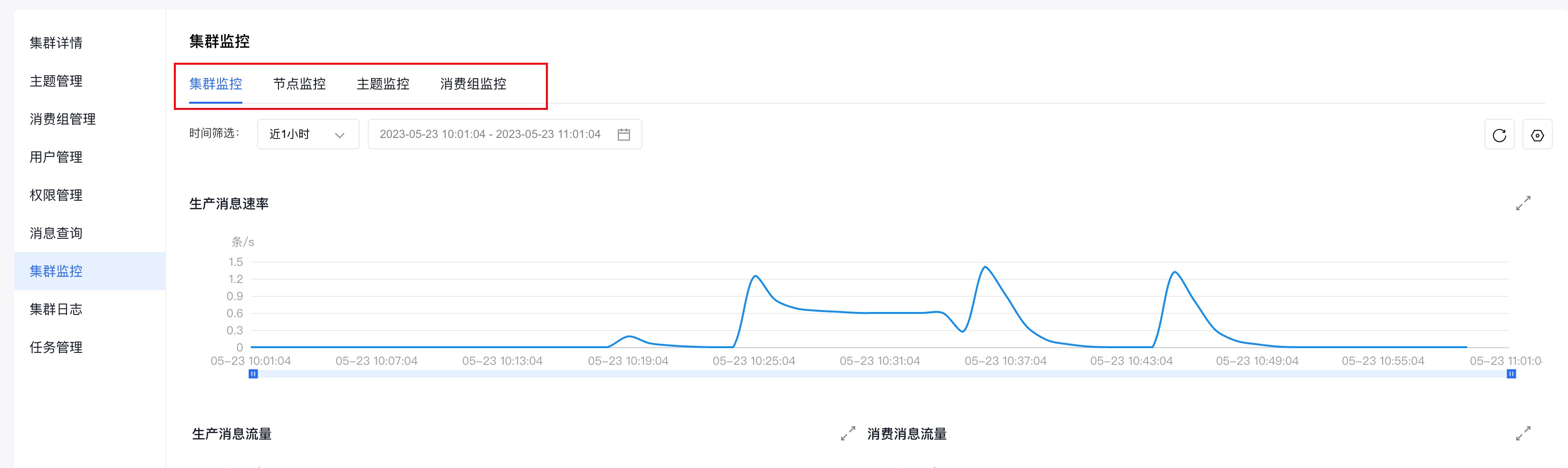
步骤四:查看集群监控
查看消息是否发送成功或消费成功有两种方式:
- 在服务器端/控制台查看日志。
- 在专享版消息服务 for Kafka控制台查看集群监控,获取集群生产、消息情况。
推荐使用第二种方式,下面介绍如何查看集群监控。
(1)在专享版消息服务 for Kafka的控制台页面找到需要连接的集群,点击集群名称进入『集群详情』页面。

(2)页面跳转后,进入左侧边中的『集群详情』页面。
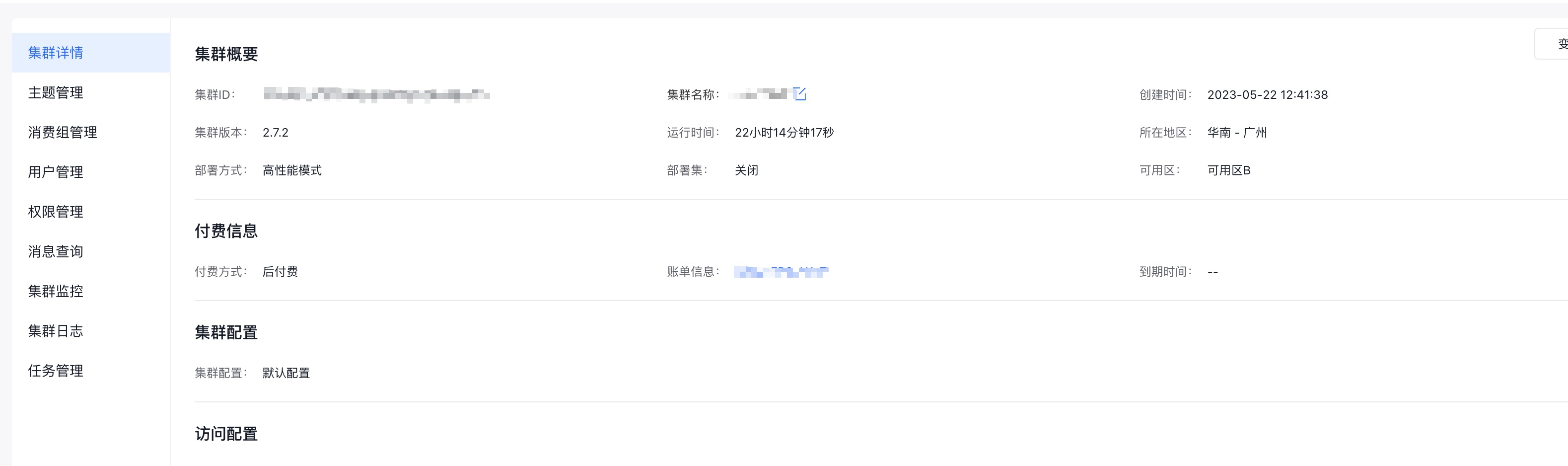
(3)点击左侧边栏中的『集群监控』,进入『集群监控』页面。
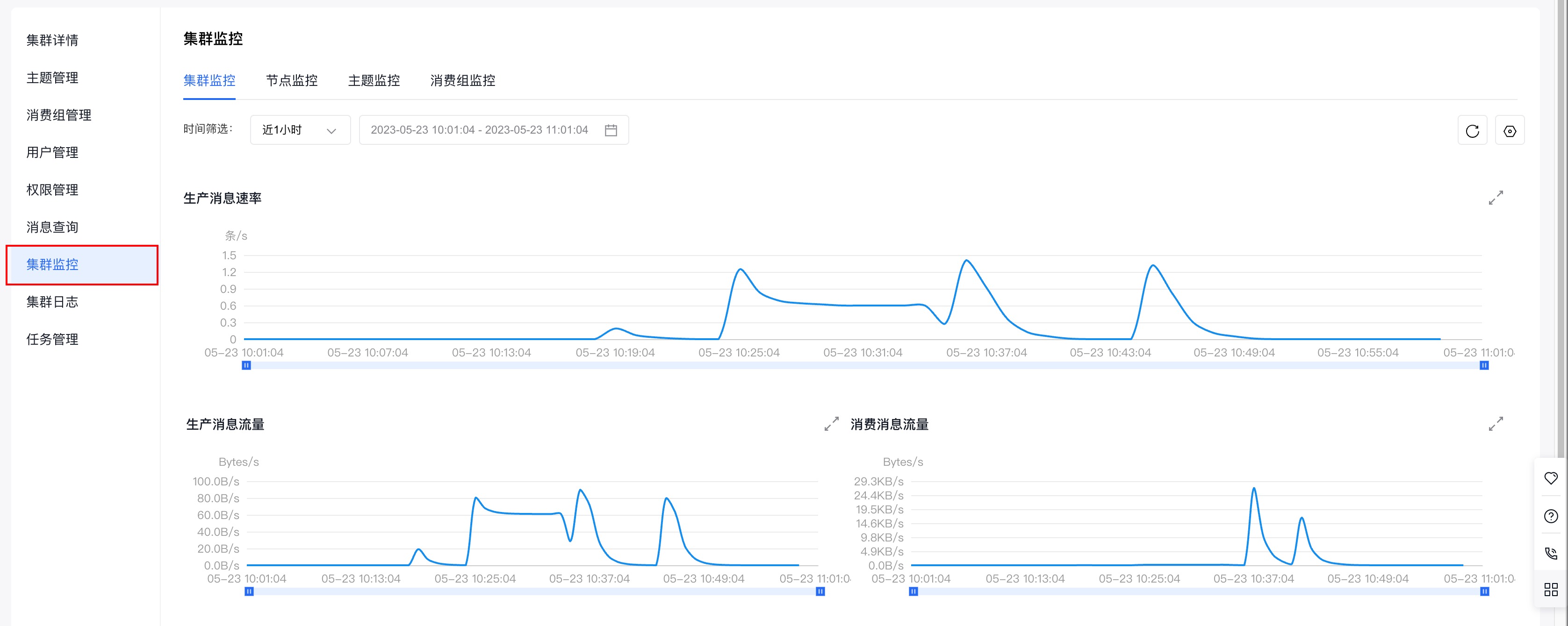
(4)通过查看『集群监控』页面,提供的不同纬度的监控信息(集群监控、节点监控、主题监控、消费组监控),即可获知集群的生产和消费情况。
集群监控的具体使用请参考:集群监控